Binary options on Australian shares are contracts whose payout depends on a condition involving a company’s share price, such as whether it finishes above a stated level at expiry. They are not share purchases. A familiar company name does not turn a fixed payout contract into an investment in that business.
ASIC prohibits the issue and distribution of binary options to retail clients in Australia. The prohibition began on 3 May 2021 and has been extended until 1 October 2031 under ASIC’s binary options product intervention order. Australian share prices do not create an exemption. The examples below explain the mechanics and risks; they are not instructions for accessing a prohibited retail product.
What an Australian Share Binary Option References
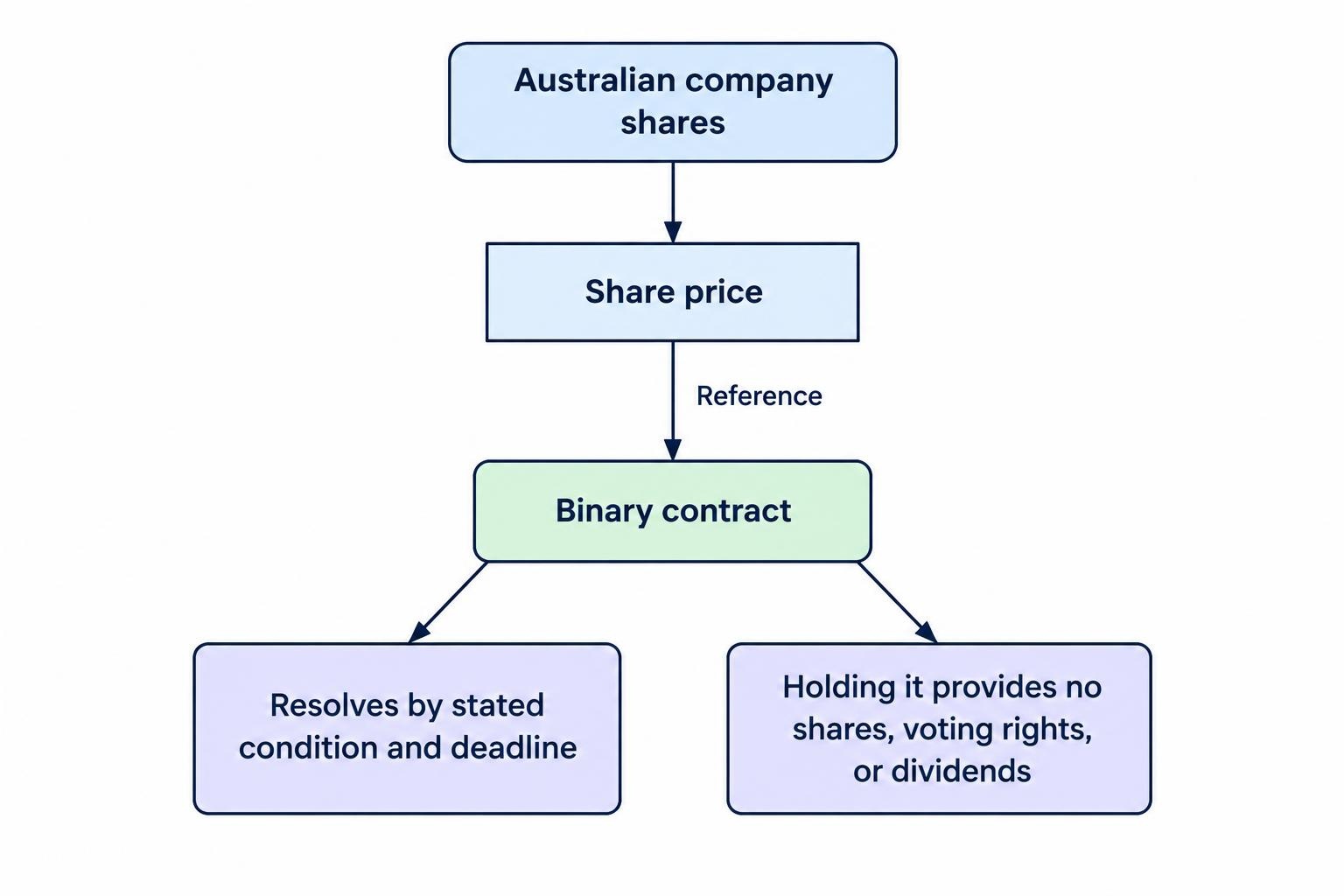
A share binary option separates the price reference from the investment itself. The underlying reference might be an Australian company’s ordinary shares, but the contract pays out under its own conditions. Holding the binary does not give you shares, voting rights or entitlement to the company’s dividends.
Consider a hypothetical contract asking whether an Australian share will finish above A$40.00 at 2:30 pm Sydney time. The answer depends on the contract’s designated settlement price at that deadline. It does not depend on whether the company has sound management, whether its annual profit grows or whether its shares rise the following morning.
That distinction matters because a sensible company assessment can still produce a losing binary outcome. A share could rise strongly over the day but finish below the strike during the few minutes covered by the contract.
The wider guide to share binary options covers the product category. For Australian shares, the extra questions concern the exact security, the Australian cash market session and the treatment of company announcements.
Identify the Security and the Price Before Analysing the Chart
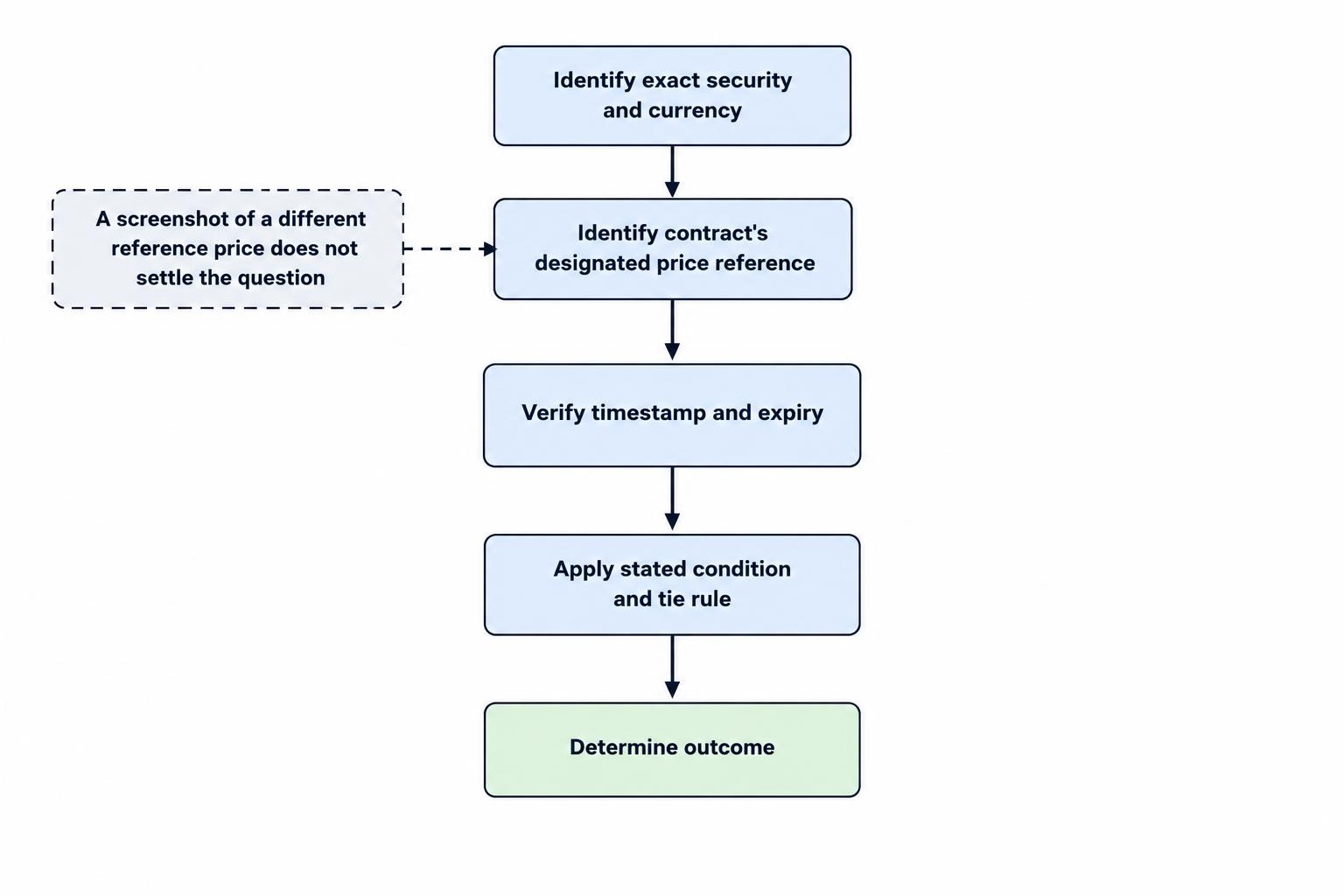
A company name is not a complete description of an underlying asset. Establish which security the contract references, where its price comes from and which currency it uses. Do not assume that an Australian business’s overseas listing or another instrument associated with it has the same price as its Australian ordinary shares.
The settlement reference also needs a precise definition. A last traded price, a bid, an offer and a midpoint can differ without any error. Comparing one of these with another can make a perfectly ordinary price difference look like a disputed result.
For example, suppose a hypothetical share has a bid of A$39.99 and an offer of A$40.01. Their midpoint is A$40.00. A condition requiring a price strictly above A$40.00 could produce different answers depending on which reference the contract specifies. A screenshot showing A$40.01 settles nothing if it displays the offer while the contract uses something else.
Check timestamps too. A delayed chart is unsuitable for auditing a contract that settles within seconds. The guide to price feeds and benchmarks covers these differences. Without an identifiable feed and settlement method, the chart cannot provide a reliable basis for evaluating the outcome.
ASX Trading Hours Affect the Meaning of Expiry
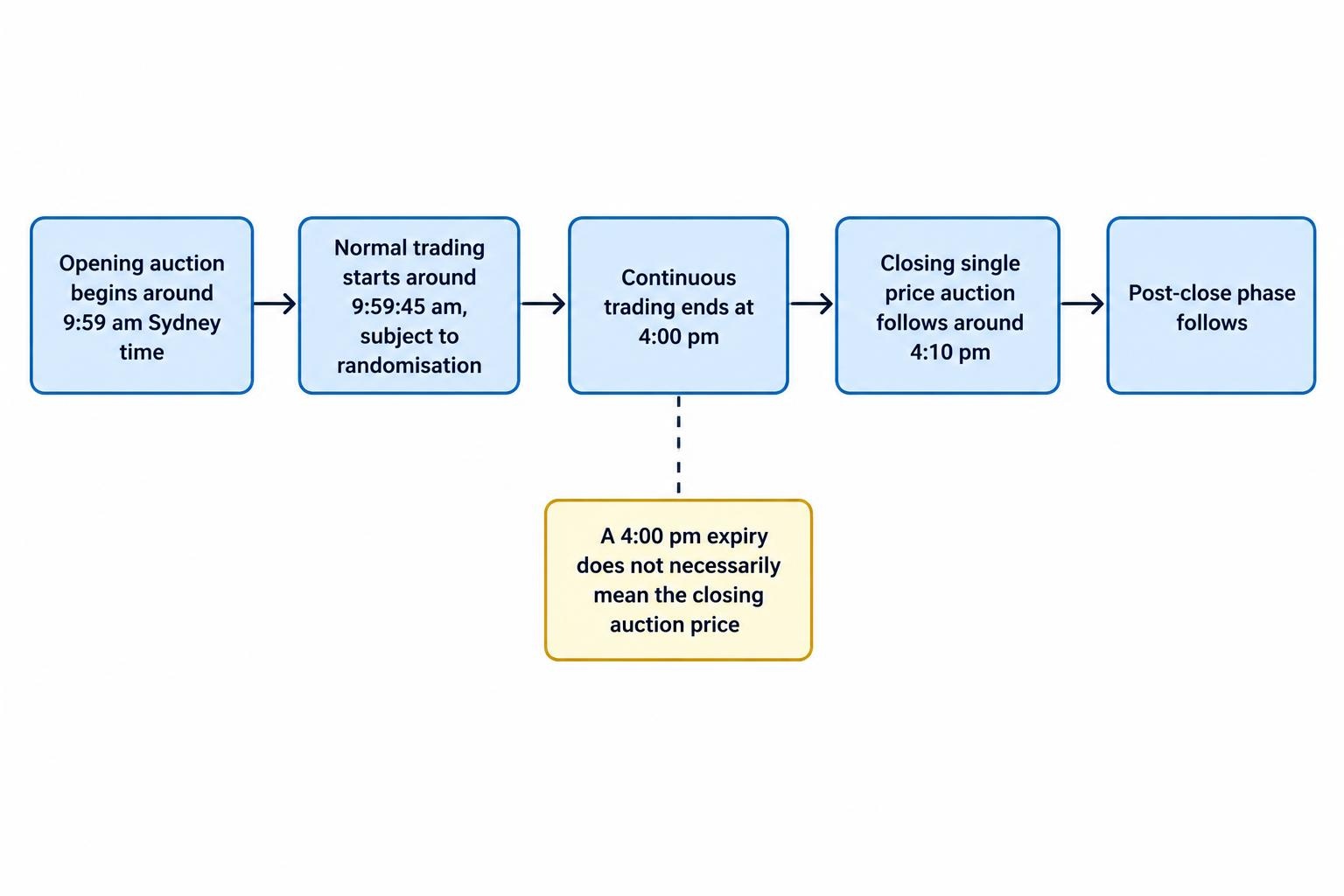
Australian share prices do not move through one uninterrupted trading session. Under the published ASX cash market trading schedule, the opening auction begins around 9:59 am Sydney time, with normal trading starting around 9:59:45 am, subject to randomisation. Normal continuous trading ends at 4:00 pm. The closing single price auction follows around 4:10 pm, with a post close phase afterwards.
These phases are not interchangeable. A contract expiring at 4:00 pm does not necessarily reference the closing auction price. “End of day” is too vague unless the terms identify the relevant phase and price.
For any paper exercise, record the expiry in Sydney local time and convert it for the date concerned. Do not rely on a platform clock without checking its time zone.
A product labelled with an Australian company name outside normal share trading also needs scrutiny. Ask what generates its quote when continuous trading is closed. A moving platform chart alone does not establish that the underlying Australian shares are trading at those prices.
Company Drivers Need to Match the Time Horizon
Australian shares should not be treated as interchangeable chart symbols. The information relevant to a resources producer can differ from the information relevant to a bank, retailer or healthcare business. Even then, identifying a business driver is not the same as predicting a price at an exact deadline.
Resources Companies: Read Beyond One Commodity
A miner’s business can span several commodities and operating regions. BHP’s results for the year ended 30 June 2026, for example, discuss copper, iron ore and coal operations. Treating such a company as a simple substitute for one commodity price leaves part of the business out of the analysis.
For a paper study, separate the commodity assumption from the company assumption. Higher commodity prices might support a business assessment, while production costs, output or previously announced expectations point elsewhere. Neither assessment tells you automatically where the share will stand in five minutes.
Interest Rates, Borrowing Costs and Demand
Interest rates affect borrowing costs, household spending, business investment and asset valuations through the RBA’s monetary policy transmission channels. Those connections help frame research into Australian companies, but they do not supply a universal trading signal.
A rate decision can have several competing implications for a business. Before assigning a direction, write down which effect your analysis relies on and why it should matter during the observation period. “Rates changed, so shares must fall” is a slogan, not a complete explanation.
The same discipline applies to company results. An assessment about the next financial year belongs to a different horizon from a contract measured in minutes. Compressing the deadline does not make the longer term evidence more precise.
Announcements, Trading Halts and Corporate Actions
Company events can interrupt the price series being studied. ASX can halt or suspend a security, including around market sensitive announcements or at a listed entity’s request. Its explanation of trading halts and suspensions also directs investors to announcements explaining the interruption.
A halt creates a contract question as well as a market question. What happens if there is no fresh qualifying price at expiry? Possible contractual treatments need to be checked rather than guessed. Do not presume that the deadline moves, the stake is refunded or the last visible chart value becomes the settlement price.
For historical analysis, mark the interruption in the record. A period without trades is not evidence that buyers and sellers repeatedly agreed on an unchanged price. Carrying an old quote forward can make an inactive period look deceptively calm.
Dividends, splits and other company events raise another issue: whether the chart has been adjusted. An adjusted historical series and a contemporaneous unadjusted quote may not be suitable for direct comparison. The separate guide to dividends, stock splits and corporate actions examines those effects. For this topic, the practical requirement is consistency between the data being studied and the proposed settlement reference.
A Hypothetical Australian Share Binary Example
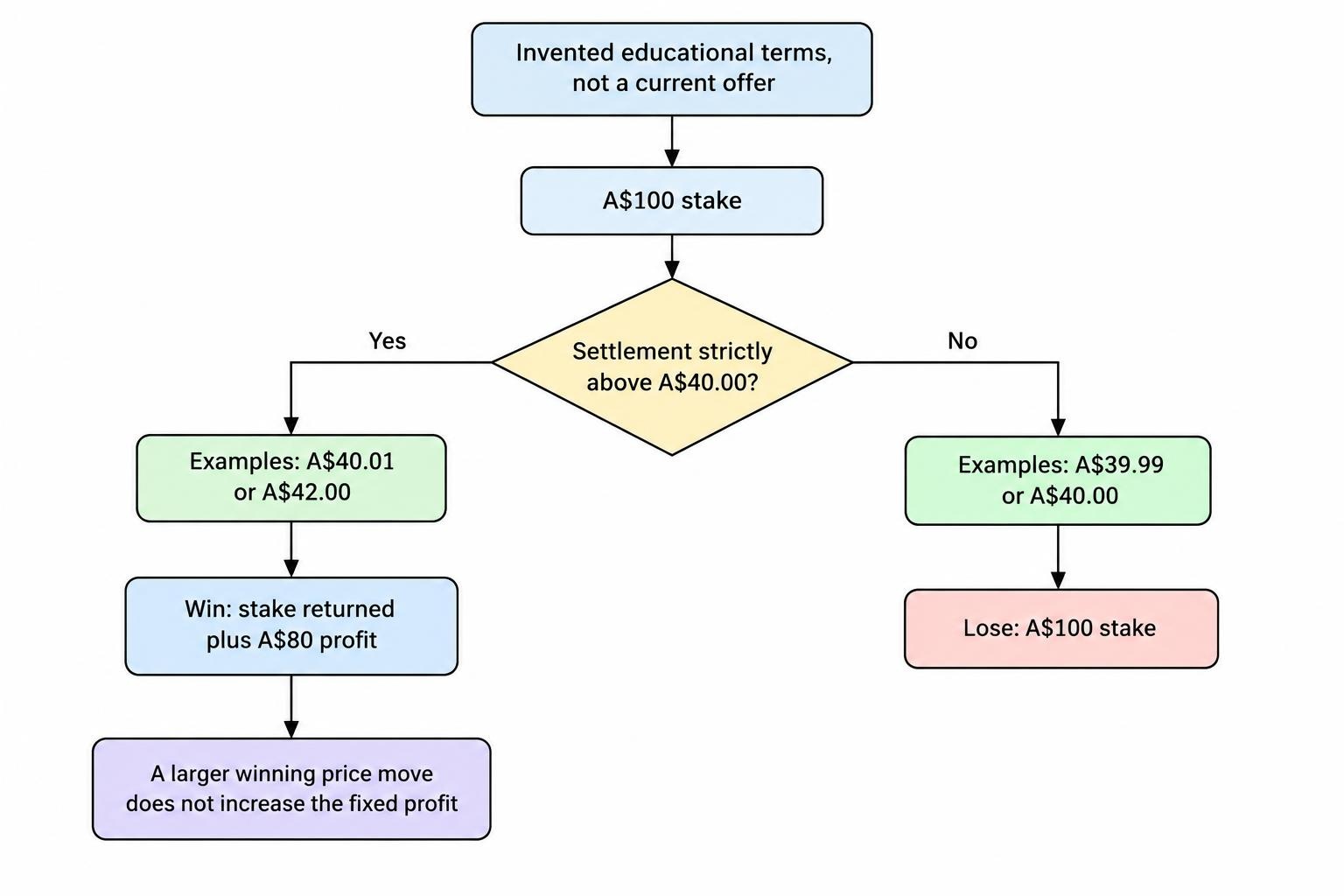
Assume an educational example with a A$100 stake, a strike of A$40.00 and a condition requiring settlement strictly above the strike. A winning outcome returns the A$100 stake plus A$80 profit. A losing outcome loses the entire stake. These are invented terms, not a current offer.
| Settlement price | Condition met? | Net result |
|---|---|---|
| A$40.01 | Yes | A$80 profit |
| A$42.00 | Yes | A$80 profit |
| A$39.99 | No | A$100 loss |
| A$40.00 | No, under the strict condition stated | A$100 loss |
The larger price rise earns no extra profit in this example. The contract pays for satisfying the condition, not for capturing the size of the share’s move. Other contracts may treat equality differently, so a tie rule must never be inferred from the chart.
The payout also changes the accuracy required to break even. With A$80 profit on wins and A$100 losses, the required win rate is A$100 divided by A$180, or approximately 55.56%, before any other costs. Fifty wins and fifty losses would produce a A$1,000 net loss.
This is why a directional forecast needs to be assessed alongside probability and expected value. Being right more often than wrong is not enough when the amounts won and lost are unequal.
How to Study Australian Share Prices Without Funding a Binary Account
A paper exercise can examine the relationship between a share price, a condition and a deadline without depositing money. Its purpose should be to test a clearly stated idea, not to produce a collection of attractive screenshots.
Choose an observation period before reviewing the outcomes. Record the security, price source, timestamp, strike, expiry and assumed payout. Use one settlement rule throughout. If a rule needs changing, start a new test rather than rewriting earlier results.
Keep the record focused on four questions:
- Was the reference price available and suitable at both entry and expiry?
- Did an announcement, halt or company event affect the observation?
- Would the result change under a different price reference or timestamp?
- Did the assumed payout leave a positive result after all losing observations?
Keep ambiguous observations visible. If the data cannot establish the outcome, label it unresolved rather than awarding a win. Excluding inconvenient cases after seeing their results can make a weak idea look persuasive.
Paper results also say nothing about whether a provider will honour a contract or process a withdrawal. Market analysis and provider risk are separate problems. A spreadsheet can investigate the former; it cannot certify the latter.
Recognising Problematic Offers to Australian Retail Clients
A company logo, Australian dollar balance or reference to an ASX share does not answer the regulatory question. Nor does the ability to open an account establish that the product may lawfully be issued or distributed to an Australian retail client.
Be particularly cautious about pressure to accept wholesale client treatment just to obtain access. Moneysmart’s binary options warning advises against doing this and warns about binary options scams and unlicensed overseas providers. Wholesale clients do not receive the same consumer protections as retail clients.
Do not let a convincing discussion of a familiar Australian business distract from the contract being sold. Knowing the company and trusting the platform are different judgments. A recognisable share name can make an unfamiliar product feel safer without changing its terms.
Match the Product to the Actual Objective
If the objective is to own part of an Australian business, receive any dividends declared and remain exposed to its performance over time, a binary contract does not provide that ownership. Its fixed condition and deadline answer a different question.
If the objective is education, a documented paper study can examine Australian share movements without requiring a binary account. If the objective is investment exposure, compare ownership, diversification, costs and the risk of loss through the alternatives to binary options, rather than choosing a product because its interface looks simple.
For Australian share binaries, the order of assessment is straightforward: establish the regulatory position, identify the security and price reference, then examine the contract conditions. Analysing the chart before answering those questions puts the least reliable part of the process first.
This article was last updated on: October 22, 2026