Commodity binary options are contracts whose outcomes depend on a commodity price meeting a stated condition within a set period. The reference market might be gold, silver, crude oil or natural gas. Buying the contract does not mean buying the commodity: the result depends on its settlement rules, not on ownership of metal, fuel or a futures position.
For Australian retail clients, the regulatory position comes first. ASIC prohibits the issue and distribution of binary options to retail clients. The ban began on 3 May 2021 and has been extended until 1 October 2031 under ASIC’s binary options product intervention order. This article explains the markets and contract mechanics for educational purposes, not as a route around that restriction.
How Commodity Binary Options Work
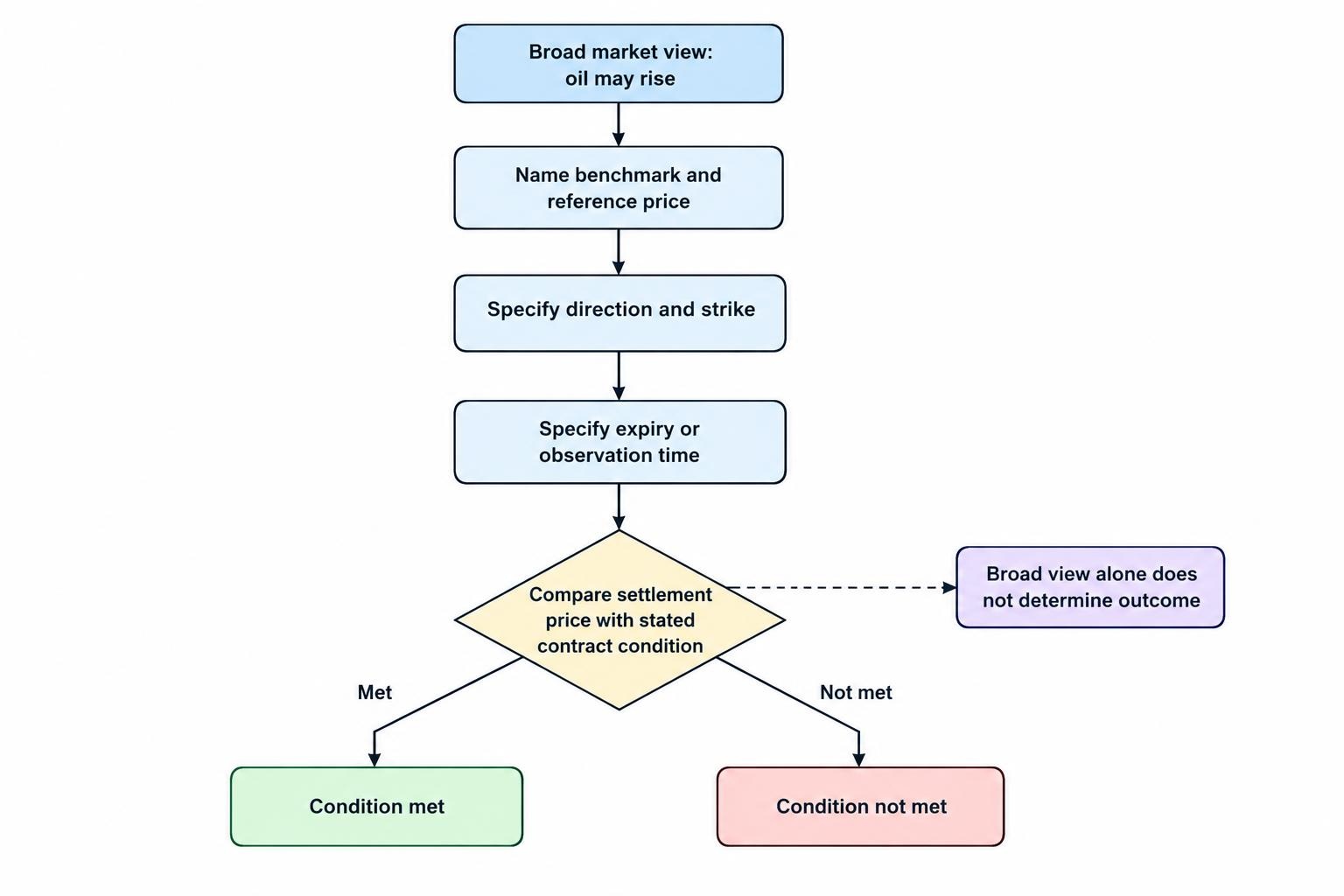
A commodity binary option turns a price condition into a contractual outcome. A high/low contract might ask whether a named oil price will finish above US$72.50 per barrel at a stated expiry time. If the condition is met, the contract pays the agreed amount. If it is not, the stake can be lost.
The size of the commodity’s move does not necessarily change the payment. Under a fixed payout contract, finishing one cent above the strike can produce the same profit as finishing one dollar above it. A large price move is not automatically a larger win.
Other contract formats ask different questions. A touch contract concerns whether a price reaches a barrier during the observation period. A range contract concerns whether the price stays within, or finishes inside, stated boundaries. These are different events, even when they reference the same commodity.
Separate the market view from the contract condition. “Oil prices may rise” is a broad opinion. “This named oil benchmark will settle strictly above this strike at this time” is a testable condition. Binary options require the latter, and being right about the broad direction is not enough.
The Commodity Name Does Not Identify the Price
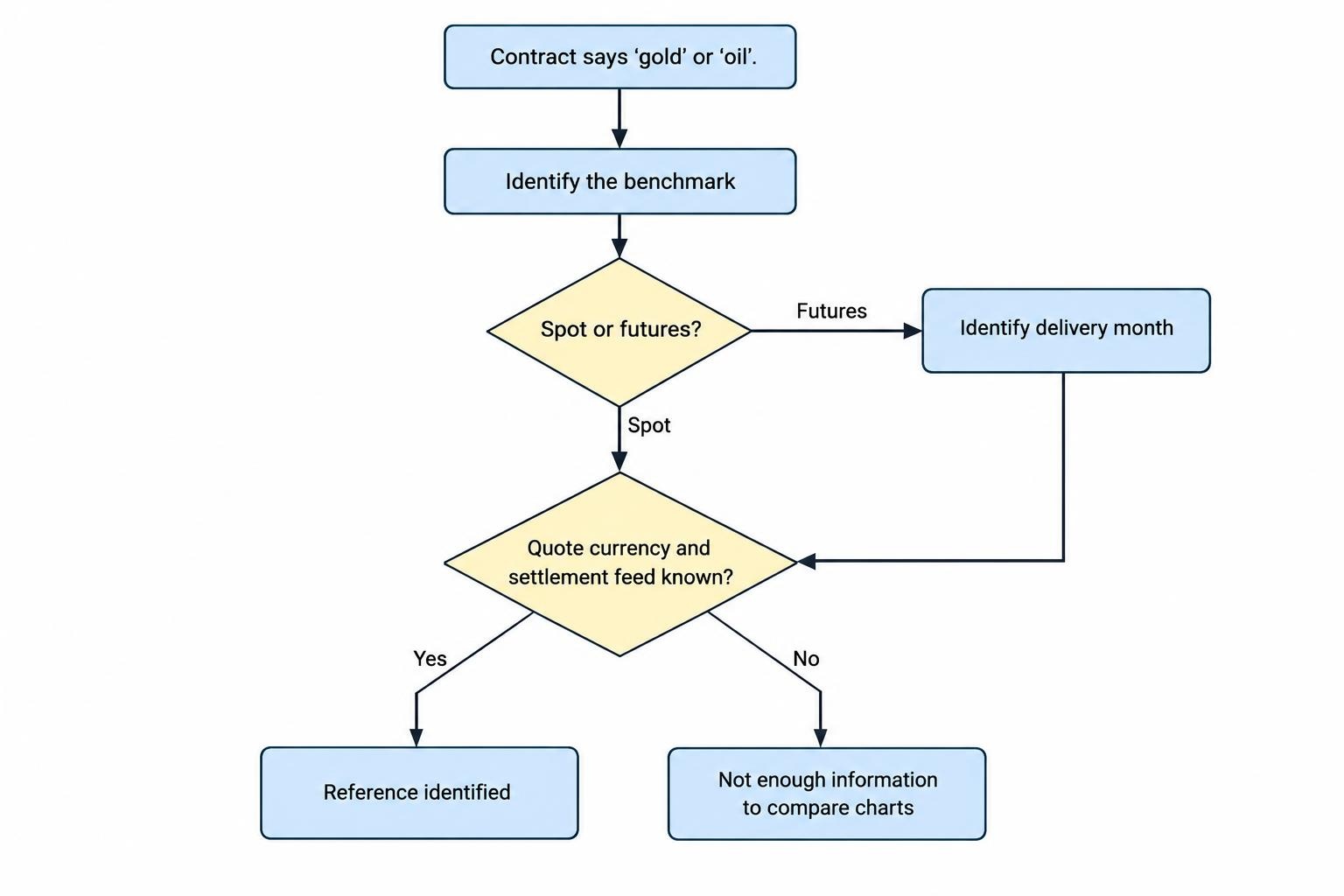
A label such as “gold” or “crude oil” leaves several questions unanswered. Which benchmark does the contract reference? Is the quote a spot price, a dated futures contract or a price calculated by the provider? Which feed determines the final result?
Spot and futures prices need not match. Storage, financing, insurance and the benefit of holding physical inventory can affect their relationship. A futures price above spot is described as contango; a futures price below spot is described as backwardation. These relationships are covered in CME Group’s explanation of commodity forward curves.
This matters when comparing charts. Suppose a binary contract references one oil futures delivery month, but the analysis chart displays another. A level marked on the second chart may not be the same level on the settlement feed. Two charts can both be valid without being interchangeable.
A rollover creates another question. When a displayed series changes from one futures delivery month to the next, a difference between those contracts can appear as a price adjustment. Do not automatically interpret that adjustment as buying or selling pressure.
Before analysing a commodity contract, record the benchmark, delivery month where relevant, quote currency and settlement feed. The distinction between commodity spot prices, futures and rollovers deserves attention before any chart pattern does.
The Main Commodity Markets
Gold, silver, crude oil and natural gas belong to the same broad asset class, but that does not make their price behaviour interchangeable. Their physical uses, supply conditions and benchmarks differ. Treating them as four versions of the same trade loses much of what matters.
Gold and silver
Gold and silver receive new supply from mining and recycling, while stored metal can also return to the market. Their demand mixes differ: gold has jewellery, investment and central bank demand, while silver also has industrial uses in electronics and photovoltaic cells. These distinctions are set out in CME Group’s precious metals supply and demand lesson.
For a gold binary contract, a broad view about demand still needs a matching timeframe. A reason to expect stronger demand over several months does not establish whether a quote will finish above a strike in five minutes. The argument and the expiry must address the same question.
Price identification matters too. A gold chart used for analysis must be compared with the contract’s actual reference, rather than assumed to match because both screens say “gold”. The gold binary options guide examines that market in more detail.
Silver should receive its own analysis rather than inherit a gold forecast. Even if two metals move in the same direction during a chosen period, that does not establish identical timing, turning points or distances from a strike.
Consider a paper exercise in which gold finishes above its strike but silver finishes below its own. There is no contradiction: each contract tests a separate price condition. The silver binary options guide covers the distinctions relevant to that metal.
Crude oil
Crude oil prices can respond to disruptions in production, transport and refining, including geopolitical events and severe weather. Supply and consumption cannot always adjust quickly, so a disruption can require a large price change to rebalance the market. The U.S. Energy Information Administration’s analysis of oil price shocks covers these mechanisms.
For a binary contract, a convincing supply argument still leaves the timing question open. A disruption might support a longer term price view without determining the next expiry result. The relevant question is not simply whether the news sounds bullish or bearish, but whether the contract’s condition follows from the evidence.
Also distinguish the benchmark. WTI and Brent are not alternative spellings of one price. A contract labelled only “oil” needs further investigation before its chart can be interpreted. The crude oil binary options guide addresses benchmark differences and oil market considerations.
Natural gas
Natural gas prices reflect production, storage, imports, exports and demand. Cold weather can increase heating demand, while hot weather can increase gas use for electricity generation. Storage can cushion demand pressure, but supply constraints can amplify price changes. These relationships are covered in the EIA’s explanation of natural gas price drivers.
A weather headline needs geographical context. Before applying it to a contract, establish whether the forecast concerns the market represented by that contract’s benchmark. “Colder weather” on its own is not a complete price argument.
For paper analysis, record the forecast region, observation period and relevant benchmark alongside the price condition. This makes it possible to check whether the reasoning was relevant, rather than attaching a convenient explanation after the result. The natural gas binary options guide develops these market considerations.
A Worked Commodity Binary Option Example
Consider a hypothetical oil contract with a stake of A$100. It pays an 80% net profit if its reference price finishes strictly above US$72.50 per barrel at expiry. Assume that an unsuccessful outcome, including an exact tie, loses the full stake. These are illustrative terms, not a product offer.
| Settlement price | Condition met? | Amount returned | Net result |
|---|---|---|---|
| US$72.51 | Yes | A$180 | A$80 profit |
| US$74.00 | Yes | A$180 | A$80 profit |
| US$72.49 | No | A$0 | A$100 loss |
| US$72.50 | No, under the assumed tie rule | A$0 | A$100 loss |
The table shows two distinctions. A larger favourable price move does not increase this contract’s profit. It also shows why equality rules matter: “above” is not the same condition as “at or above”. Check the actual terms rather than assuming a tie produces a refund.
The commodity quote and stake currency serve different purposes. Here, the oil condition uses a US dollar price, while the hypothetical account payment uses Australian dollars. The contract does not give the holder a barrel of oil or a proportional share of its price movement.
Payouts Determine the Required Success Rate
A simple directional choice does not create even odds or a fair payout. In the example above, each successful A$100 stake earns A$80, while each unsuccessful stake loses A$100.
Ten successes and ten losses would therefore produce A$800 in profits against A$1,000 in losses: a net loss of A$200, before any other charges.
With a constant 80% net profit rate, full stake losses and no refunds or extra costs, the break even success rate is:
1 ÷ (1 + 0.80) = approximately 55.56%.
That percentage is a mathematical threshold, not evidence that a strategy can reach it. Changing the payout changes the threshold. A record of correct forecasts is incomplete unless it also records the payments available on those forecasts.
For paper research, judge results using both accuracy and contract economics. The fuller explanation of probability and expected value in binary options shows why a high success rate can still accompany losing results.
Expiry and Settlement Can Outweigh the Broad Forecast
A commodity forecast needs a time horizon. An argument about the next quarter cannot, by itself, justify a contract expiring in the next minute. Shortening the expiry does not make the original argument more precise; it asks a different question.
Separate the underlying market’s futures expiry from the binary contract’s expiry as well. A binary contract could reference a futures price while settling much earlier than that futures contract matures. The two dates perform different jobs.
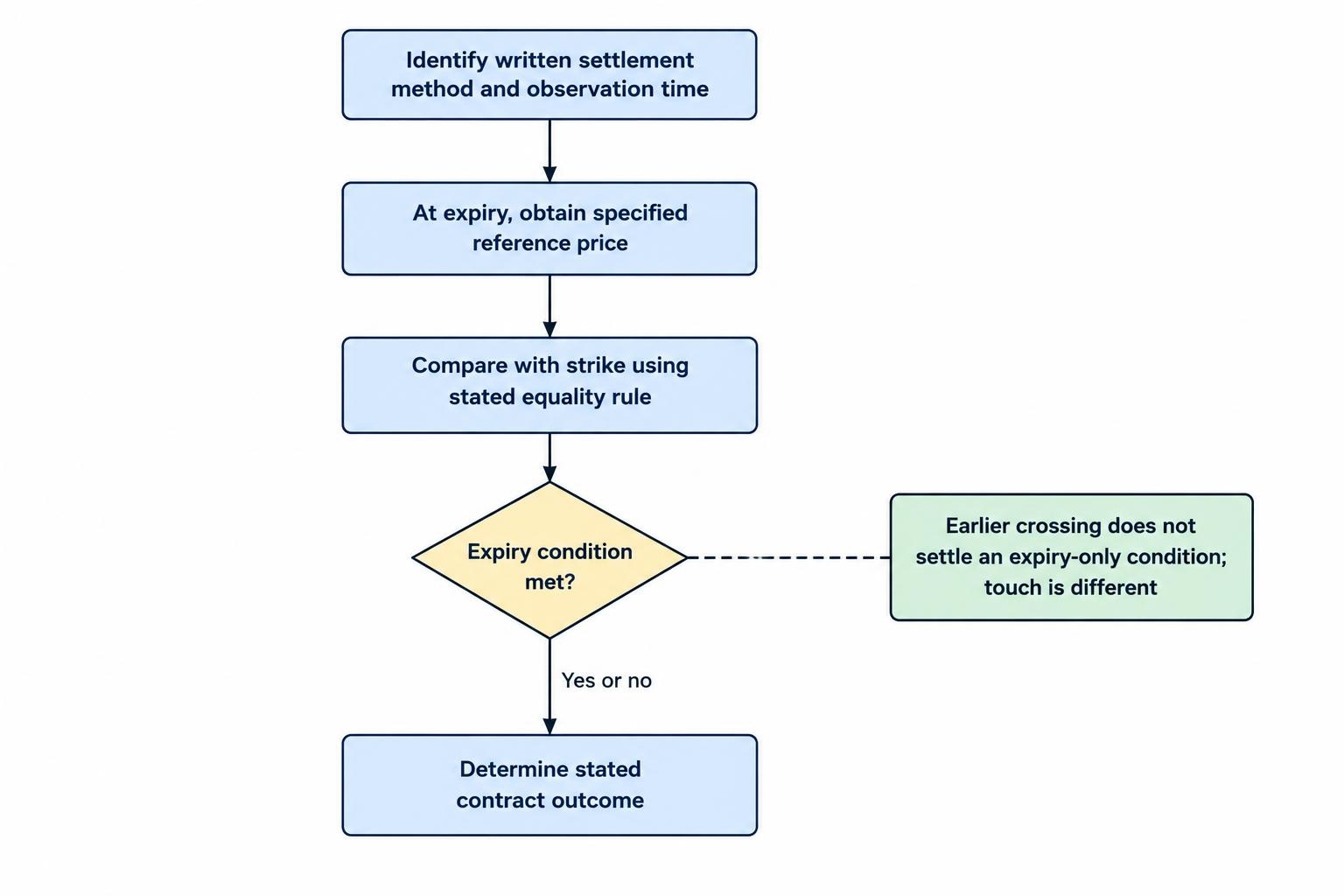
In a hypothetical high/low contract, the reference price might rise above the strike, fall back below it and then finish below it. That contract would lose under an expiry-only condition, despite spending time in a favourable position. A touch condition would require a different assessment.
The settlement method also needs to be identifiable. Does the contract use one observation, an average over a window or a published benchmark? Does it use the last traded price, a bid, an offer or another calculation? An analysis chart is useful only if its relationship to that method is clear.
If the observation window or final price source cannot be established, the result cannot be independently checked with confidence. A moving chart is not a substitute for written settlement terms.
What to Record in a Commodity Paper Exercise
For Australian retail readers, studying historical data or using a paper worksheet avoids treating education as an invitation to fund a binary options account. The exercise should test whether the price condition was well defined and whether the forecast addressed it.
Keep the record short enough to maintain consistently, but detailed enough to reconstruct the result:
- Reference market: commodity, benchmark, futures delivery month where relevant and data feed.
- Contract condition: strike, direction, observation period, expiry time, time zone and equality rule.
- Economics: hypothetical stake, net profit percentage, loss amount and any assumed charges.
- Reasoning and result: the forecast written before expiry, the settlement observation and the calculated outcome.
Record unsuccessful observations under the same rules as successful ones. If the data is missing or the settlement price cannot be verified, mark the result unresolved rather than choosing whichever chart makes the forecast look better.
Keep market reasoning separate from contract administration. A forecast can be poorly reasoned and still succeed once. It can also be well reasoned but address a timeframe that the contract does not cover. The record should make both errors visible.
Commodity Exposure Is Not Commodity Ownership
A commodity binary option provides exposure to a defined event, not ownership of the underlying resource. It does not reproduce the return from holding bullion, owning a commodity fund or maintaining a futures position. The payoff structure is different.
This distinction also matters when considering protection against rising physical costs. A fixed payment tied to one observation does not automatically match the amount, timing or benchmark of a business’s fuel bill. Sharing the word “oil” does not make two exposures equivalent.
The most useful starting point is therefore the contract specification, not a prediction. Identify the price, condition, expiry, settlement method and payment structure. Only then can the commodity research be assessed against the question the contract actually asks.
This article was last updated on: October 22, 2026