Trading records for tax purposes should show what happened to your money, not just the balance left in an account. For binary options, preserve the original trade history, settlement details, deposits, withdrawals, fees and currency conversions. Your calculations should connect each reported amount to evidence that another person can check.
Australia’s ASIC ban on issuing and distributing binary options to retail clients remains in force until 1 October 2031. This guide concerns record keeping for past transactions and other accounts requiring tax review. It does not endorse accessing offshore platforms.
What Trading Records Should You Keep?
Build your records around three things: the contract, the money movement and the calculation. A bank statement proves that money moved, but does not explain which contracts settled or whether a payment represented returned funds, trading proceeds or something else.
Keep a separate file for each account, including accounts that have closed. Record the account holder, account number, account currency and the legal entity named in the agreement. Preserve the terms that applied to the transactions, rather than relying on whatever terms appear on the platform now.
| Record | Details to preserve | Purpose |
|---|---|---|
| Account identity | Account holder, account ID, contracting entity and currency | Connects transactions to the correct taxpayer and account |
| Contract details | Trade ID, underlying market, direction, strike and contract terms | Identifies what was entered into |
| Dates and times | Opening, expiry and settlement timestamps, including time zone | Supports review of timing and financial year allocation |
| Trade amounts | Stake, gross settlement credit, returned stake and net result | Separates money returned from profit or loss |
| Adjustments | Refunds, voided contracts, bonuses, reversals and corrections | Explains movements outside ordinary settlements |
| Cash movements | Deposits, withdrawals, fees and payment references | Allows reconciliation with bank or wallet records |
| AUD calculations | Original currency, exchange rate, rate date, method and AUD amount | Makes currency conversions reproducible |
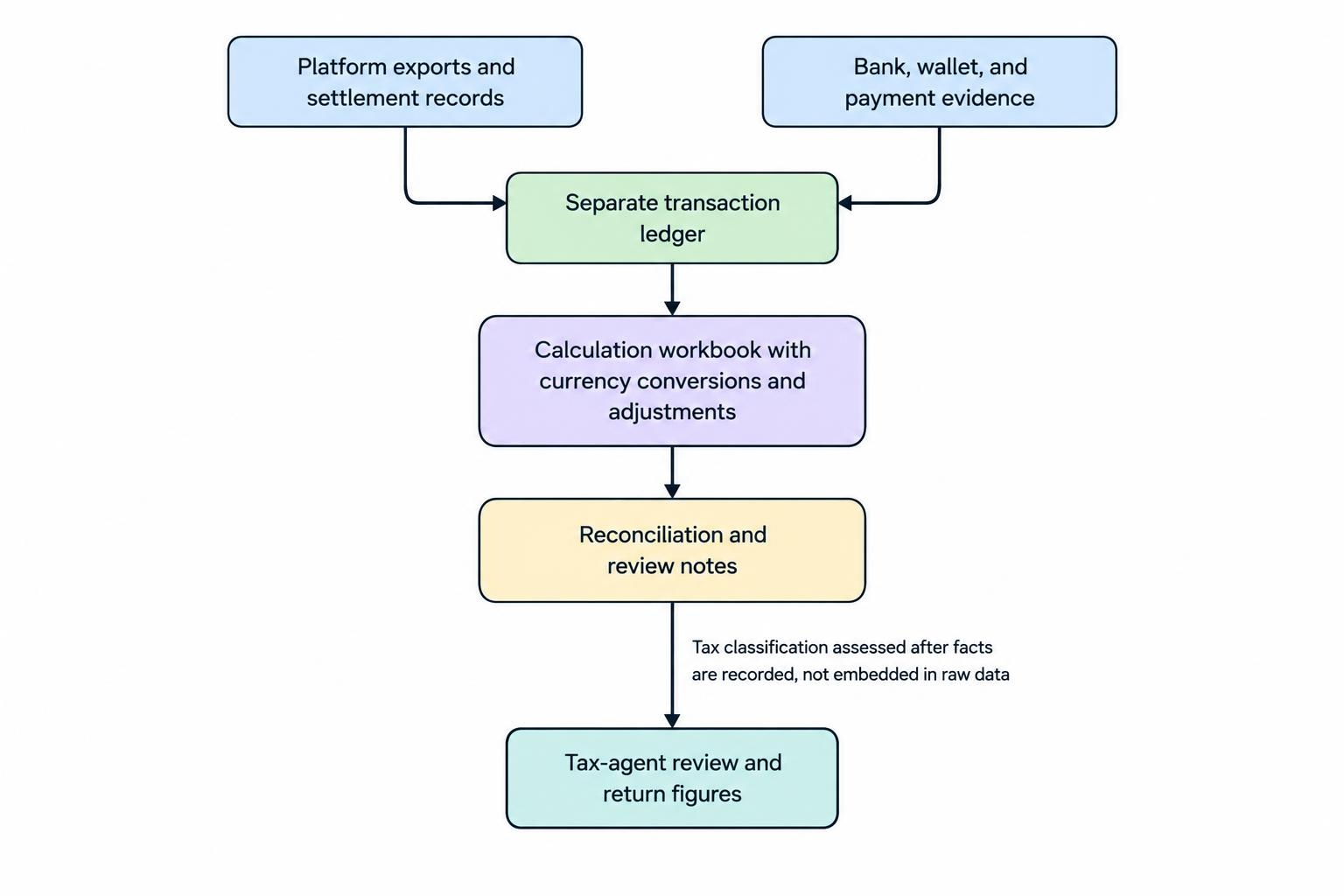
Export the full transaction history in CSV format where available, alongside readable statements or confirmations. Keep the untouched export and perform calculations in a separate workbook. Screenshots can preserve a disputed settlement or missing field, but they should supplement the ledger, not become the ledger.
Separate Evidence From Tax Classification
A complete ledger does not decide whether a receipt is assessable income or a loss is deductible. Avoid building those assumptions into the raw data. Preserve the facts first, then record the treatment adopted and the reasoning behind it.
The distinction between income and capital tax treatment needs a separate assessment. Give your registered tax agent the contracts, account history and a factual description of the activity. Do not assume that a platform’s “profit” column belongs unchanged in a particular tax return field.
Maintain a short activity note covering why the account was opened, how decisions were made, trading frequency and any changes during the year. If there is uncertainty about treatment, preserve the advice received and the facts supplied to obtain it. A label such as “trader” is less useful than a clear account of what actually happened.
Record Payouts Without Counting the Stake Twice
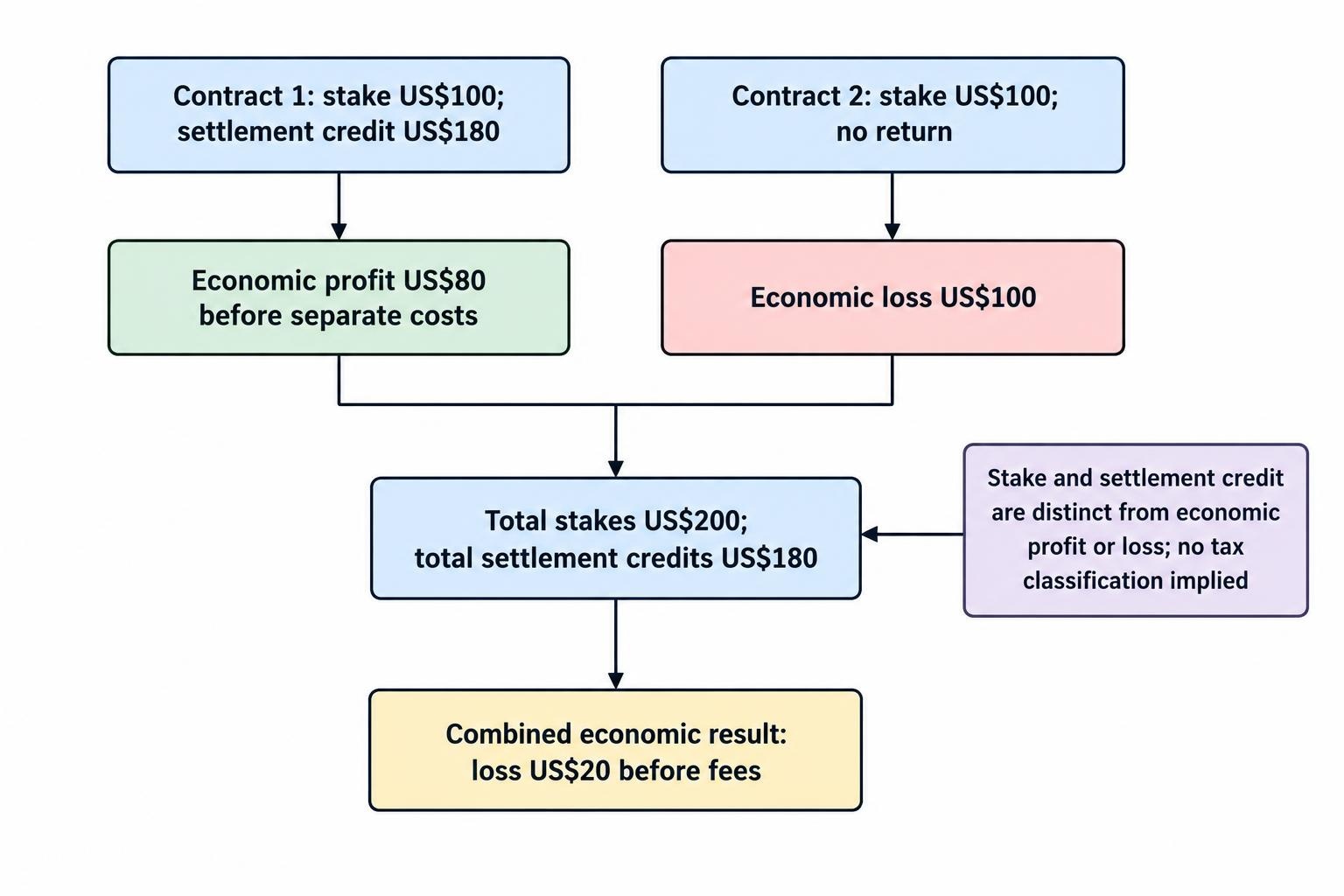
Check what each exported amount means before adding it up. A settlement credit that includes the original stake is not the same as net profit. Copy the platform’s field descriptions into your working notes so those meanings remain clear later.
Consider an illustrative settled contract with a US$100 stake and a US$180 settlement credit. The economic profit is US$80 before separate costs. If another US$100 contract expires with no return, its economic loss is US$100. Together, the two contracts produce a US$20 economic loss before fees.
Keep the US$200 total stakes, US$180 total settlement credits and US$20 net loss visible as separate figures. This preserves the calculation without deciding its tax treatment. Record refunded stakes and voided contracts separately too, so a refund does not accidentally appear as a winning trade.
Reconcile the Account Before Preparing Tax Totals
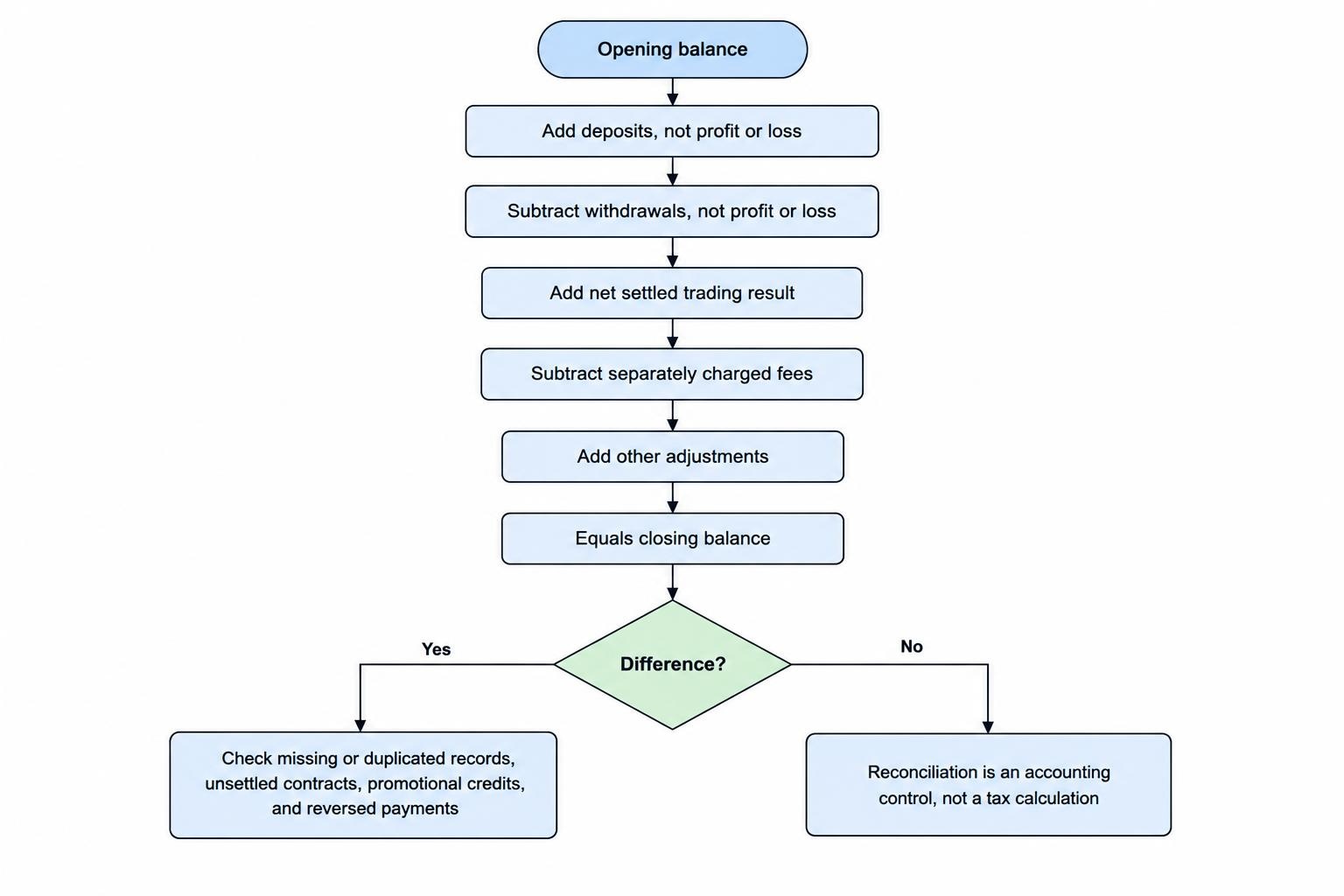
Reconciliation checks whether the transaction ledger explains the account balance. It is an accounting control, not a substitute for a tax calculation.
For a cash account with no unsettled positions or restricted credits, a useful check is:
Opening balance + deposits − withdrawals + net settled trading result − separately charged fees + other adjustments = closing balance.
Suppose an account starts at zero, receives a US$1,000 deposit and pays out a US$300 withdrawal. The settled contracts produce a US$20 loss and the account incurs US$10 in separate fees. With no other movements, the closing balance should be US$670.
The US$300 withdrawal is not automatically US$300 of profit. Nor does the US$1,000 deposit describe the trading loss. Both are funding movements that must be matched against the transaction history.
Investigate any difference rather than posting an unexplained balancing entry. Check for missing export pages, duplicated rows, unsettled contracts, promotional credits and reversed payments. If a fee is already included in a reported net result, do not subtract it again.
Match deposits and withdrawals to external statements as well. Where a bank debit differs from the amount credited to the account, retain the payment receipt and any conversion or fee breakdown.
Keep Foreign Currency Amounts and AUD Workings
Preserve the original currency amounts even when preparing an AUD summary. Otherwise, a later reviewer cannot distinguish trading performance from the effect of currency conversion.
Foreign income, deductions and foreign tax paid must be converted to Australian dollars before inclusion in an Australian return. The applicable rate depends on the relevant rules; the ATO foreign exchange rate guidance covers transaction rates and average rates. Do not assume an annual average suits every amount.
Your conversion worksheet should record the foreign amount, relevant date, exchange rate, rate provider, calculation and resulting AUD value. State the direction of the quote. “1 USD = 1.50 AUD” is much harder to misread than an unexplained “1.50”.
Using an assumed rate of 1 USD = 1.50 AUD, a US$100 amount converts to A$150. That demonstrates the arithmetic only. It does not establish which date or rate should apply to an actual transaction.
Ask your adviser to review how foreign currency balances are handled, rather than converting only the final withdrawal. Keep funding records and trading records separate so both can be assessed.
Preserve the Financial Year Cut-Off
Organise the working files around the Australian income year, normally 1 July to 30 June, rather than accepting a calendar year export as the finished annual record. Download overlapping periods if needed to check transactions around the boundary.
Keep the original timestamp and stated time zone. Add a separate converted timestamp where useful, naming the Australian time zone used. Do not overwrite the original date.
For contracts open around 30 June, preserve the opening details, settlement confirmation and year end account statement. Flag them for review instead of assigning them to a year solely because of the date the platform credited the account. A clear cut-off schedule makes the timing question visible.
Keep Expense Evidence Without Assuming Deductibility
Create an expense schedule separate from the trade ledger. Record payment processing charges, account fees, currency conversion charges, software subscriptions and professional fees for review, without marking every item as deductible.
For each expense, keep the invoice or receipt, payment evidence, supplier name, service description and relevant period. Add a short explanation of its connection to the activity. If a service also has private use, record that fact and preserve the basis of any proposed allocation.
The useful distinction is between recording an expense and claiming it. Your files should let an adviser assess the payment without having to reconstruct what a vague bank description meant. Also identify costs already deducted within platform settlement figures to prevent double counting.
Keep a Separate Trail for Crypto-Funded Accounts
Where cryptocurrency funded an account, preserve both sides of the movement: the wallet or exchange transaction and the credit recorded by the platform. Neither record replaces the other.
The ATO crypto record requirements include transaction dates, counterparties, receipts, exchange records and Australian dollar values at transaction times. Keep the asset, quantity, network, transaction hash, destination address and fees in your supporting schedule.
Record what each movement actually did. Was it a transfer between wallets you controlled, a sale into fiat currency, or a transfer in exchange for an account credit? Preserve the evidence rather than treating every outgoing wallet transaction as an identical “deposit”.
For the tax questions beyond record keeping, see tax considerations for crypto-funded trading accounts. Supply transaction evidence to your adviser, not seed phrases or private keys.
How Long Should You Keep Trading Tax Records?
Most individual tax records have a five year retention period, but the starting point and exceptions matter. The ATO rules on records you need to keep set out the general requirements and situations requiring longer retention. Do not delete a file simply because five years have passed since the trade.
Maintain a retention note for each annual folder. Include the return lodgment date, whether records support a later year, and any unresolved review or dispute. Ask your adviser to confirm the disposal date where different rules may apply.
If capital gains tax treatment is relevant, records generally need to remain available for at least five years after the relevant CGT event. Records supporting a net capital loss used later may need longer retention, including through the review period for the year in which the loss is fully applied. The ATO capital gains record guidance addresses these exceptions.
Keep the calculations behind any amount carried forward, not just the latest balance. Preserve the original evidence, earlier returns and schedules showing how the amount changed. Retention supports a claim; it does not make the claim valid. The separate guide to tax treatment of binary options losses covers that distinction.
Store Originals and Rebuild Missing Records Carefully
Use a folder for each financial year, with subfolders for original exports, statements, payments, expenses, currency workings and tax advice. Put a version date on calculation files and retain the version used for the lodged return.
Keep a protected backup outside the device used for day to day work. Check that files open correctly and that exported dates, decimal places and transaction IDs have survived the import. A spreadsheet can look tidy while silently turning an account reference into a number.
Where records are missing, start with bank statements, payment receipts, settlement emails, saved exports and wallet histories. Request replacements from the relevant provider where possible. Label reconstructed entries, identify the evidence used and flag gaps. Do not invent individual trades to force the closing balance to agree.
Prepare a Reviewable Pack for Your Tax Agent
Give your tax agent a short account summary supported by the detailed files. A useful handover contains:
- Account schedules: holders, contracting entities, currencies and opening and closing balances.
- Transaction evidence: original exports, settlement records and a reconciled ledger.
- Calculation schedules: AUD conversions, expenses, adjustments and any carried forward amounts.
- Review notes: missing records, disputed payments, year end positions and questions about treatment.
Ask the adviser to confirm the treatment adopted, the return entries and the retention period. Preserve that advice with the supporting workings. The broader guide to binary options tax in Australia provides context for those decisions.
A useful tax file lets another person follow the trail from the original transaction to the reported figure. That is the standard to aim for: complete evidence, explained differences and calculations that can be repeated without guessing.
This article was last updated on: October 22, 2026