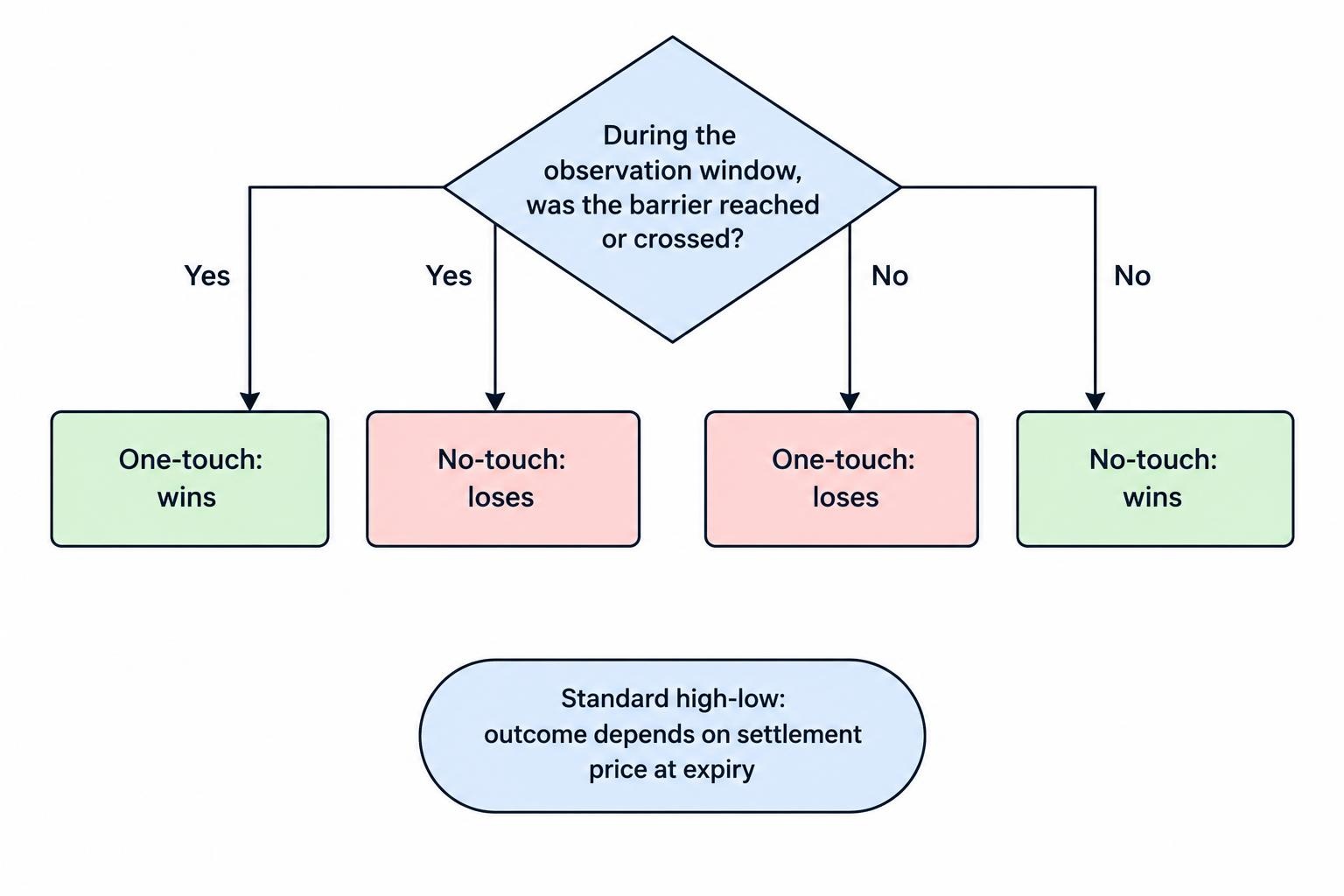
One-touch and no-touch binary options depend on whether a price reaches a preset barrier during an observation period. A one-touch contract pays if the barrier is reached; a no-touch contract pays if it remains untouched. The route price takes matters, not just where it finishes.
Australian retail restriction: ASIC’s prohibition on issuing and distributing binary options to retail clients took effect on 3 May 2021 and extends until 1 October 2031. The examples below explain contract mechanics, not an available Australian retail trading opportunity. See ASIC’s announcement extending the binary options ban.
How One-Touch and No-Touch Options Work
Both contracts start with an underlying market, a barrier price and an observation period. The barrier can sit above or below the starting price. An upper barrier tests whether price rises far enough; a lower barrier tests whether it falls far enough.
Under the standard touch convention, reaching the barrier counts: price does not have to move beyond it. A one-touch pays a fixed amount if that event occurs, otherwise it pays nothing. A no-touch reverses the condition. These definitions and the distinction between payment at the hit and payment at expiry appear in the MathWorks touch option contract documentation.
Once a qualifying touch occurs, a later reversal does not erase it. For a no-touch, returning to the safe side of the barrier does not restore the winning condition.
| Contract | Winning condition | Does the final price decide everything? |
|---|---|---|
| One-touch | The observed price reaches or crosses the barrier during the agreed period. | No. An earlier touch can decide the outcome. |
| No-touch | The observed price never reaches or crosses the barrier during that period. | No. An earlier touch defeats the condition. |
| Standard high-low | The settlement price meets the above-or-below condition at expiry. | Yes, subject to the settlement rules. |
This separates barrier contracts from a simple forecast that a market will finish higher or lower. The broader guide to binary option types compares these different payoff conditions.
Worked Examples: The Same Barrier, Opposite Outcomes
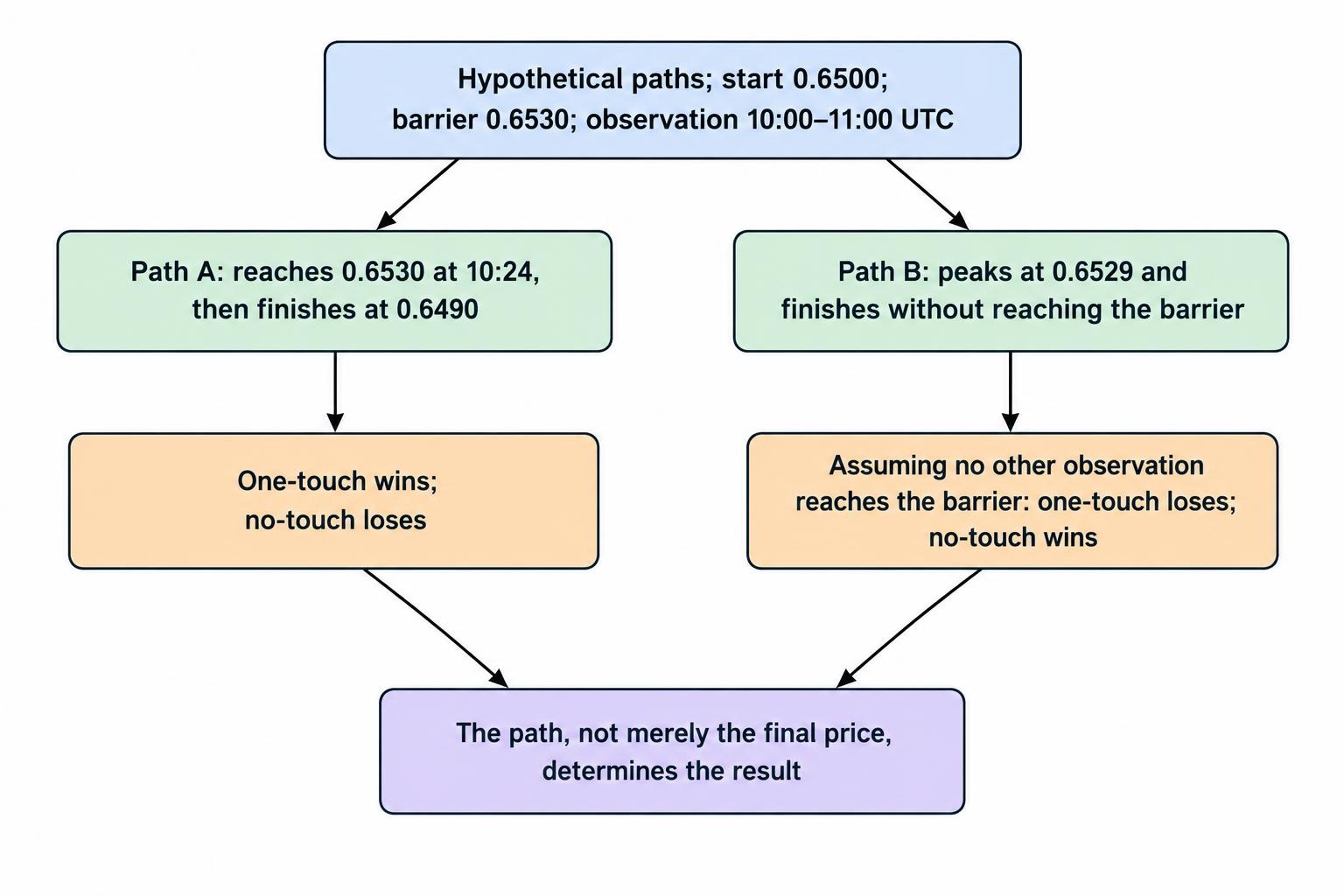
Assume a hypothetical AUD/USD contract starts with the exchange rate at 0.6500. Its upper barrier is 0.6530, and observation runs from 10:00 to 11:00 UTC. Every qualifying quote during that hour counts, including the final observation.
For each example, assume an A$100 stake buys a contract returning A$180 in total if successful, including the original stake. A winning result therefore produces A$80 profit; a losing result loses A$100. These are teaching figures, not current quotes.
One-touch: A brief visit is enough
At 10:24, the qualifying price reaches 0.6530. It then falls and finishes at 0.6490.
The one-touch condition succeeds. Although AUD/USD ends below its starting price, it reached the upper barrier during observation. The total return is A$180 and the net profit is A$80 under the assumed terms.
Now change the path: AUD/USD rises only to 0.6529 before falling. The one-touch fails because the barrier was not reached. Being almost right does not produce an almost payout.
No-touch: Finishing below the barrier is not enough
Apply a no-touch condition to the original path. The visit to 0.6530 at 10:24 defeats the contract, even though the final price is comfortably below the barrier. The assumed loss is A$100.
If the highest qualifying price had instead been 0.6529, and no other observation reached the barrier, the no-touch would succeed when observation ended.
A lower barrier works in reverse. With a barrier at 0.6470, a qualifying price at or below 0.6470 triggers the touch condition. Neither contract requires the market to remain there for the rest of the period unless the terms expressly add such a requirement.
Barrier Distance, Time and Volatility
Distance must be judged against the observation period
A barrier’s distance from the starting price tells only part of the story. A target 30 pips away over five minutes poses a different question from the same target over several days.
There is also a useful logical comparison. On the same observed price path, reaching a farther upper barrier requires passing the nearer upper barrier under continuous price movement. Moving a target farther away does not make the touch task easier. For a no-touch, moving that upper boundary farther away gives price more room before failure.
That does not establish whether either contract offers fair value. The purchase price or promised return must also be compared.
More time changes the event being purchased
Holding the barrier and observation rules unchanged, extending the period adds opportunities for a touch. A barrier reached after 40 minutes defeats a one-hour no-touch but would not affect a contract whose observation ended after 30 minutes.
Distinguish the time you submit an order, the time observation starts and the time it ends. A touch outside the agreed window is a different event. The guide to binary options expiry times covers those timing distinctions.
Volatility is not a shortcut to a winning trade
As a practical inference, larger price excursions can help a touch target become reachable and make avoiding a barrier harder. But “the market will be volatile” is not enough to evaluate a contract. Direction, barrier placement, observation time and price paid still matter.
Test the forecast in plain language: “Will this market reach this level before this deadline?” That is more useful than a general claim that a currency pair or commodity looks lively.
What Counts as a Touch?
The contract’s observation rules deserve as much attention as its barrier. A chart line alone cannot settle every question.
Continuous observation checks for a barrier event throughout the agreed window. Discrete observation checks at stated times. These are different contract conditions with different valuation implications, addressed in the research paper A Continuity Correction for Discrete Barrier Options.
Suppose a hypothetical price touches the barrier at 10:24:30 but moves away before 10:25. A contract observing qualifying prices throughout the minute can record that event. One checking only at whole-minute timestamps might not. Neither result can be assessed without knowing the agreed schedule.
Check the price source and quote basis
Read which price is observed: bid, ask, midpoint, last traded price or a named benchmark. Also check whether the underlying is a cash market, a futures contract or another reference series.
Consider an illustrative quote with a bid of 0.6529 and an ask of 0.6531 against a barrier at 0.6530. An ask-based test and a bid-based test can produce different answers. A screenshot showing only one chart series may not establish what the contract observed.
Use the guide to price feeds and benchmarks to separate the displayed chart from the reference used to determine the result.
Check equality, gaps and the final observation
Confirm whether the condition says “touches,” “at or beyond,” or something else. Check how it handles a quote that jumps from one side of the barrier to the other without displaying the exact barrier price.
The terms should also state whether the expiry timestamp is included and what happens during missing data or market interruptions. A rule that sounds minor before entry can decide the entire payoff afterwards.
Payouts, Profit and Break-Even Probability
A payout percentage is not a probability estimate. It is also meaningless until you know whether it describes profit or total money returned.
In the earlier example, A$100 produces A$180 back on success. That is an A$80 profit, or an 80% profit return. Calling the same transaction a “180% payout” would describe the gross return instead. The cash flows have not changed; the label has.
For a contract that loses the full stake on failure, returns the stake plus profit on success, and has no other costs:
Break-even win probability = stake ÷ total return on a win.
Using the hypothetical figures, A$100 ÷ A$180 gives approximately 55.56%. Across repeated contracts with those same terms, a 50% success rate would not break even.
Over ten contracts, five wins would produce A$400 profit, while five losses would cost A$500. The net result would be a loss of A$100. This is arithmetic, not a forecast of actual results.
The probability needed is the probability of the touch event, not the probability of finishing above the barrier. A model that predicts only the closing price answers the wrong question. The guide to probability and expected value develops that comparison further.
Touch and no-touch outcomes are complements only when they use exactly the same barrier, observation window and event rules, with no extra outcomes such as cancellation. Their quoted prices need not form a cost-free hedge. Do not assume buying both sides removes the possibility of losing money.
Double One-Touch and Double No-Touch Options
Double barrier contracts place one boundary above the starting price and another below it.
A double one-touch succeeds if either boundary is reached. It does not ordinarily require both. A double no-touch succeeds only if neither boundary is reached during observation. These conditions are set out in the MathWorks double barrier contract documentation.
For a hypothetical starting price of 100, set barriers at 95 and 105. A qualifying move to 105 satisfies the double one-touch and defeats the double no-touch, even if price returns to 100 before expiry.
This is not the same as testing whether the final price lies inside a range. A market can finish between 95 and 105 after having crossed either boundary earlier. Always distinguish “stays inside throughout observation” from “finishes inside at expiry.”
Do not infer the condition from the product name alone. Read the event definition, particularly where a contract combines different requirements at its upper and lower barriers.
When the Outcome Is Known and When Money Is Paid
A qualifying touch can establish a one-touch win before expiry, but that does not automatically mean cash becomes available immediately. A contract can provide for payment at the hit or defer payment until expiry.
A successful no-touch requires the observation period to finish without a barrier event. Its failure can become known earlier, but success cannot be confirmed while more qualifying observations remain.
Keep three questions separate: has the payoff condition been decided, has the account been credited, and can the money be withdrawn? A statement about one does not answer the others.
Payment and platform risks are separate from market analysis. The joint CFTC and SEC investor alert on binary options fraud documents complaints involving denied withdrawals, identity theft and software manipulation. These are reported categories of alleged misconduct, not evidence that every disputed touch is fraudulent.
How to Study Touch Contracts Without Depositing Money
A paper exercise can test whether you have interpreted the condition correctly. Choose a historical price series, define a barrier and observation window, then write the rules before inspecting the later prices.
- Record the reference price, quote basis and observation schedule.
- Identify the first qualifying barrier event, if one occurs.
- Calculate the hypothetical cash result using an explicit stake and total return.
- Mark cases where the available data cannot establish the outcome.
That final step matters. A candle’s high may show that an upper barrier was reached somewhere within the candle, but it does not necessarily reveal the timestamp needed to assess a shorter observation window. Do not turn uncertain data into a confident result.
The paper trading guide provides a broader framework for recording such exercises. For touch contracts, the central discipline is straightforward: define the observed price, the barrier and the clock before judging the outcome. A forecast about where price finishes cannot replace a test of where it went along the way.
This article was last updated on: October 22, 2026