Cryptocurrency market hours and cryptocurrency volatility are different questions. A market can remain open around the clock while participation, available liquidity and price movement change from one hour to the next. Continuous access does not mean consistent conditions, and a busy chart does not make price direction easier to predict.
For Australian readers, the regulatory position comes first. ASIC’s binary options product intervention order bans the issue and distribution of binary options to retail clients until 1 October 2031. The discussion below is educational, not a recommendation to use an offshore platform.
The practical task is to separate three things: when the underlying cryptocurrency market operates, when a particular contract is available, and how prices behave during the period being studied.
Does Cryptocurrency Trade 24 Hours a Day?
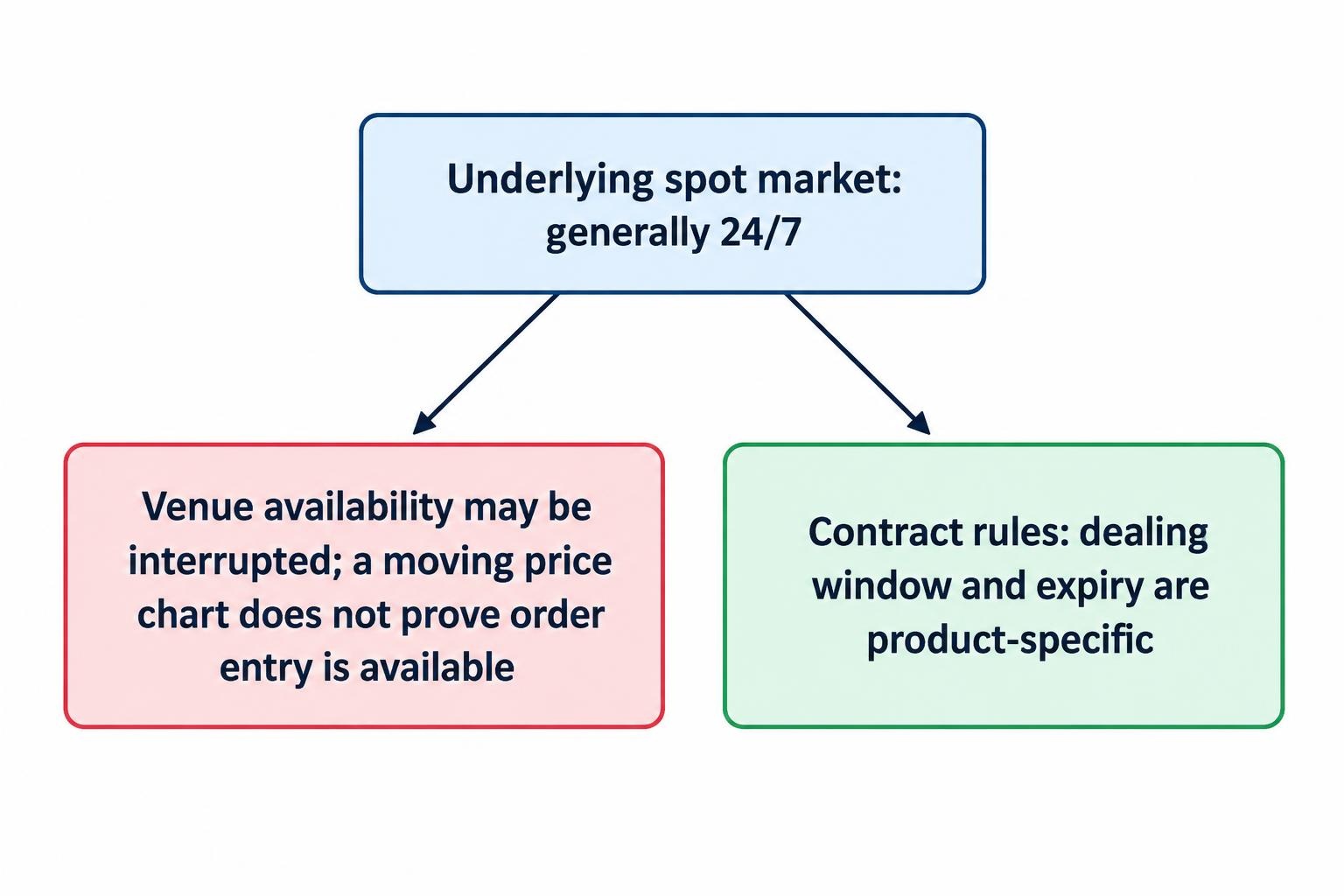
Spot cryptocurrency markets generally operate 24 hours a day, seven days a week, including weekends. There is no single opening bell for Bitcoin or Ether across all venues. However, an individual venue can interrupt trading for maintenance, technical problems or changes to a particular market.
Do not assume that every financial product linked to cryptocurrency follows the same timetable. An exchange traded product, a futures contract and a binary option are different instruments. Their operating hours come from their own market rules or contract terms, not simply from the availability of the underlying coin.
Schedules also change. CME Group’s cryptocurrency futures trading hours now provide trading throughout the week, subject to maintenance windows and product exceptions. Its published schedule includes a two hour Saturday maintenance window, while spot quoted futures are excluded from the general 24/7 arrangement. Older descriptions of all CME crypto derivatives closing for the weekend should not be treated as current rules.
For any cryptocurrency linked binary contract being examined, distinguish the dealing window from the expiry time. A platform might stop accepting new contracts before an existing contract settles. A chart might continue displaying prices even when order entry is unavailable. Neither a moving chart nor an active countdown proves that a new transaction can be accepted.
What Cryptocurrency Volatility Actually Measures
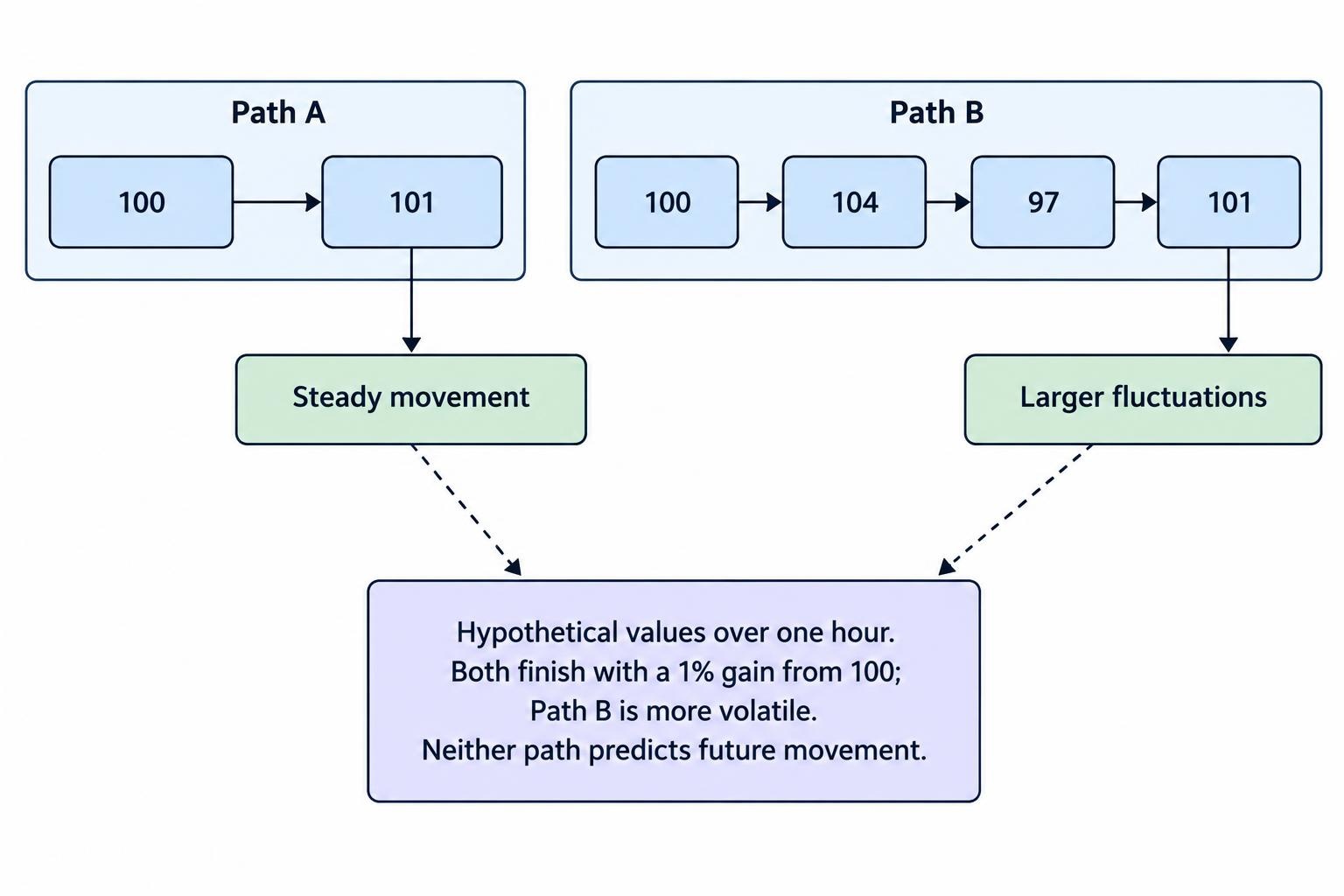
Volatility describes how much prices fluctuate over a defined period. It does not identify whether the next move will be up or down. A market that repeatedly rises and falls can be highly volatile while finishing close to where it started.
Consider two hypothetical hourly price paths. In the first, a cryptocurrency moves steadily from US$100 to US$101. In the second, it moves from US$100 to US$104, falls to US$97, then finishes at US$101. Both produce a 1% closing gain, but the second involves much larger fluctuations.
This distinction matters when comparing cryptocurrency markets. A daily percentage change measures the difference between two prices. It does not describe every movement between them. The broader guide to cryptocurrency binary options covers the underlying product context; here, the focus is the timing and behaviour of those prices.
Match the measurement to the question. An hourly range can help describe an hourly observation period. It says much less about the price behaviour inside a particular ten second interval. Likewise, a volatile week does not establish that every minute within it was volatile.
Historical volatility measures past fluctuations. It is not a promise about the next observation window. Treat it as a description of the sample, not a timetable for the next large move.
Why Weekend Conditions Need Separate Analysis
Weekend trading should not automatically be labelled either safer or more volatile. The useful distinction is between trading volume, liquidity and volatility.
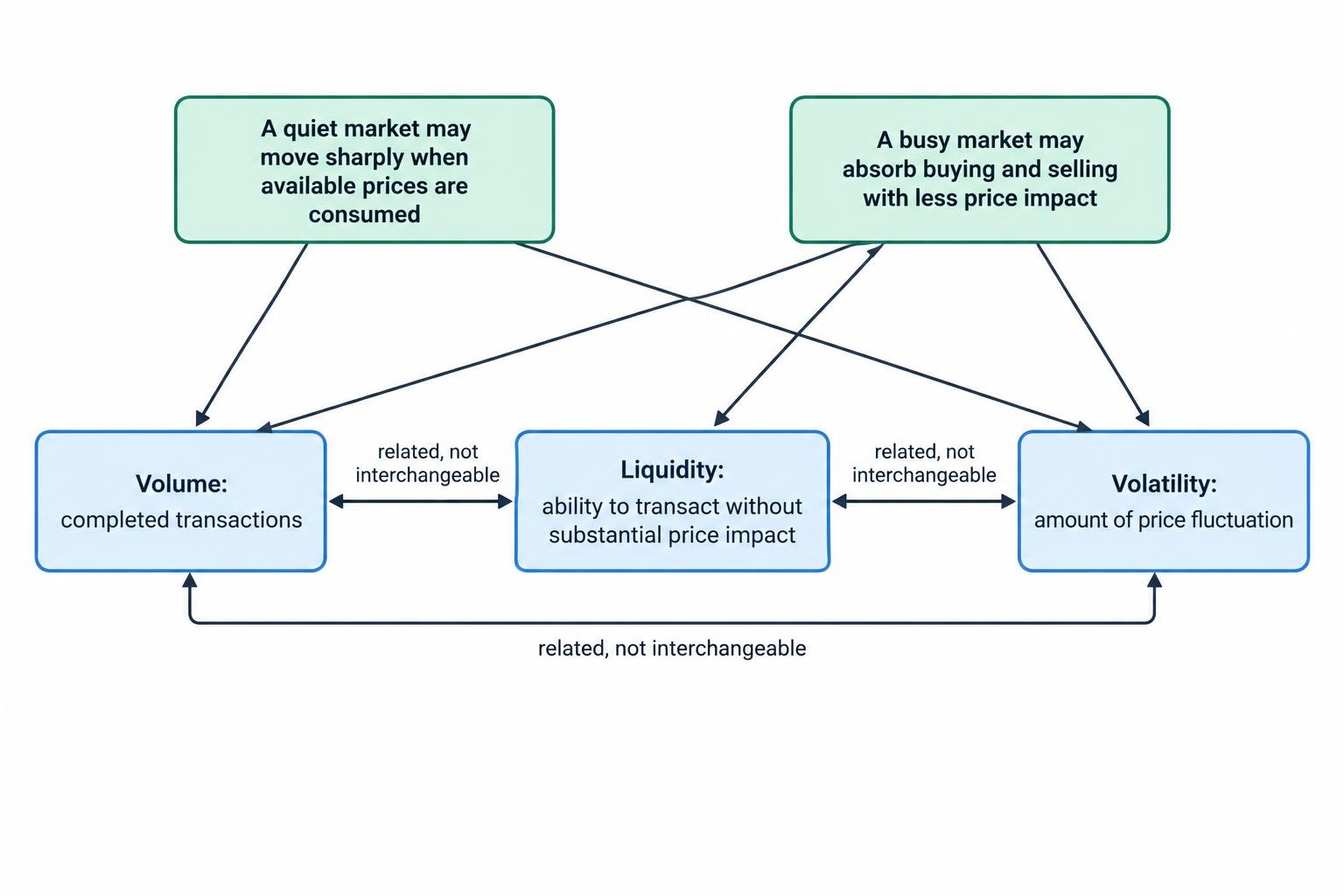
Volume records completed transactions during a period. Liquidity concerns the ability to transact without moving the price substantially. Volatility describes price fluctuations. These measures are related, but they are not interchangeable.
A quiet market can show little movement until an order arrives that consumes the available prices. A busy market can absorb substantial buying and selling without the same price impact. Conversely, heavy activity can accompany sharp repricing when participants react to new information.
Historical evidence also varies by trading pair. Kaiko’s January 2024 research on weekend Bitcoin activity found that weekend volume in fiat quoted Bitcoin markets reached a record low in its 2023 data, while stablecoin quoted markets showed a less pronounced decline. That finding describes a dated sample, not a permanent rule for every cryptocurrency or venue.
The practical implication is to compare like with like. BTC/USD on one venue and BTC/USDT on another are not identical datasets. Neither should be used as a shortcut for all cryptocurrency activity.
For weekend analysis, record the pair, venue, observation period and any unusual event. Avoid turning “Saturday looked quiet” into “weekends are predictable.” A market does not become easier to forecast because fewer people appear to be watching it.
Is There a Best Time to Study Cryptocurrency Markets?
There is no defensible universal answer such as “always use the London afternoon” or “avoid every Sunday.” A useful observation period depends on the asset, venue, event calendar and question being tested.
Cryptocurrency prices should not be treated as detached from other financial markets. ESMA’s research on crypto market structure and liquidity, published in April 2024, identified co-movement with equities and substantial differences in liquidity between exchanges. Its findings support examining both broader market conditions and the venue behind the data, rather than relying on a coin’s name alone.
Regional sessions are useful labels for organising research. You could compare the same pair during Asian business hours, European business hours and US business hours. Those labels are starting points for measurement, not evidence that one period offers a reliable advantage.
Separate scheduled announcements from ordinary periods. An interest rate decision or inflation release creates a defined event window to investigate. Record the actual publication time, then examine price behaviour before and after it. Do not assume that the announcement’s headline tells you which direction the price should take.
Unexpected events need a different label. A security incident, trading disruption or sudden policy announcement does not arrive neatly inside a recurring session. In derivatives markets, automatic position closures can also add buying or selling pressure when margin becomes insufficient. These are mechanisms to consider, not reasons to assume every sharp move has the same cause.
Converting Cryptocurrency Market Hours to Australian Time
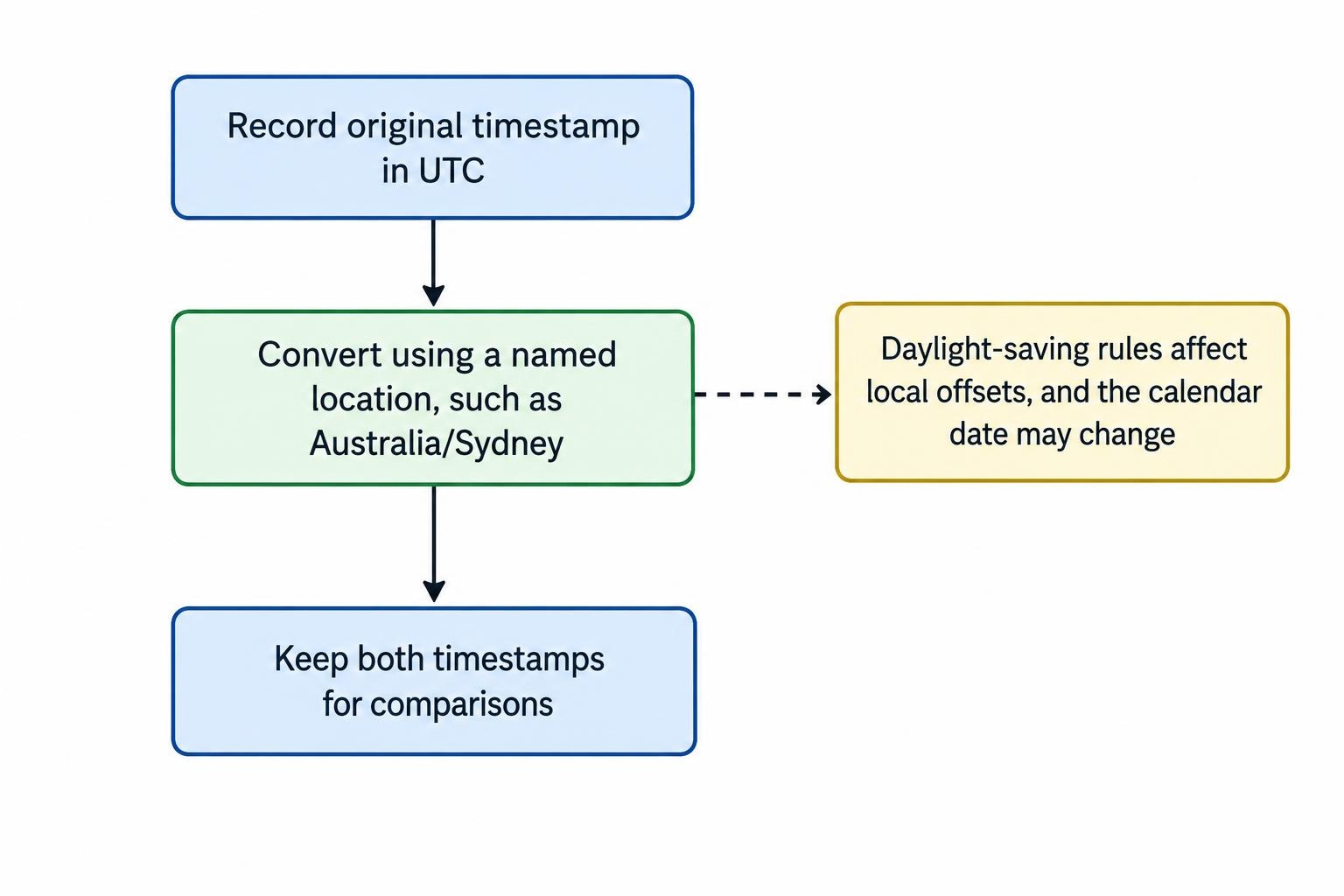
Use UTC as the common reference in research records, then add local time for convenience. This makes comparisons easier when chart settings, platform clocks and event calendars use different time zones.
AEST is UTC+10, AEDT is UTC+11 and AWST is UTC+8. Queensland does not observe daylight saving, while Sydney and Melbourne use AEDT during their daylight saving period. The NSW Department of Education’s Australian time zone reference sets out these offsets and the distinction between standard and daylight time.
| UTC | AWST, UTC+8 | AEST, UTC+10 | AEDT, UTC+11 |
|---|---|---|---|
| 00:00 | 08:00 | 10:00 | 11:00 |
| 13:30 | 21:30 | 23:30 | 00:30 next day |
| 20:00 | 04:00 next day | 06:00 next day | 07:00 next day |
Pay attention to the calendar date as well as the hour. An event marked Friday in UTC may occur on Saturday morning in Australia. A weekend comparison can become muddled if one dataset uses UTC dates and another uses local dates.
Keep the original timestamp alongside the converted one. For software records, prefer a named location such as Australia/Sydney over an unexplained “Australian time” label. Always check which time zone the platform actually displays.
How Volatility Interacts With Binary Options Expiry
For a simple above or below binary contract settled at expiry, the final qualifying price determines the outcome under the contract terms. A large earlier move does not guarantee a favourable settlement. Direction and timing must both match the stated condition.
Take a hypothetical contract with a strike of US$100,000 that requires the settlement price to finish strictly above that level. The reference price rises to US$100,800 during the contract but finishes at US$99,990. The earlier rise does not satisfy the expiry condition. These figures illustrate mechanics only; they are not current Bitcoin prices.
Higher volatility does not automatically improve the chance of success. For a distant strike, wider fluctuations might increase the chance of reaching the required area. For another position, they might increase the chance of moving away from it. The effect depends on the starting price, strike, remaining time and settlement rule.
Nor does a larger favourable move necessarily produce a larger payment. In a fixed payout contract, finishing far beyond the strike can pay the same amount as finishing just beyond it. More movement is not the same as more reward.
Keep contract duration separate from chart resolution. A one minute candle is a display interval, not proof that a contract lasts one minute. The guide to binary options expiry times covers this distinction in more detail.
A longer expiry also changes the period exposed to new information. It does not simply turn a difficult short contract into an easier one.
Price Feeds Matter More Near a Threshold
When a settlement price is close to the strike, small differences in the relevant data can matter more than a broad view of the market. Before interpreting an outcome, establish which price the contract uses.
A displayed value could represent a last traded price, a bid, an ask or a calculated index. Do not substitute one for another without checking the terms. Likewise, do not assume that an external chart reproduces the contract’s settlement feed.
The same caution applies to apparent pauses. A flat chart could reflect unchanged prices, missing updates or a display problem. Without checking timestamps and feed status, the picture alone cannot distinguish between them.
The guide to price feeds and benchmarks covers those distinctions. For volatility and market hours research, the narrower requirement is consistency: use an identified feed, preserve its timestamps and document any change in the data.
A continuously available underlying market does not establish that every quote is fresh or every platform is functioning normally. Treat feed quality and market availability as separate checks.
A Practical Observation Plan
For Australian retail readers, a paper based observation exercise can examine market behaviour without funding a binary options account. The objective is to test claims about timing, not to manufacture a reason to transact.
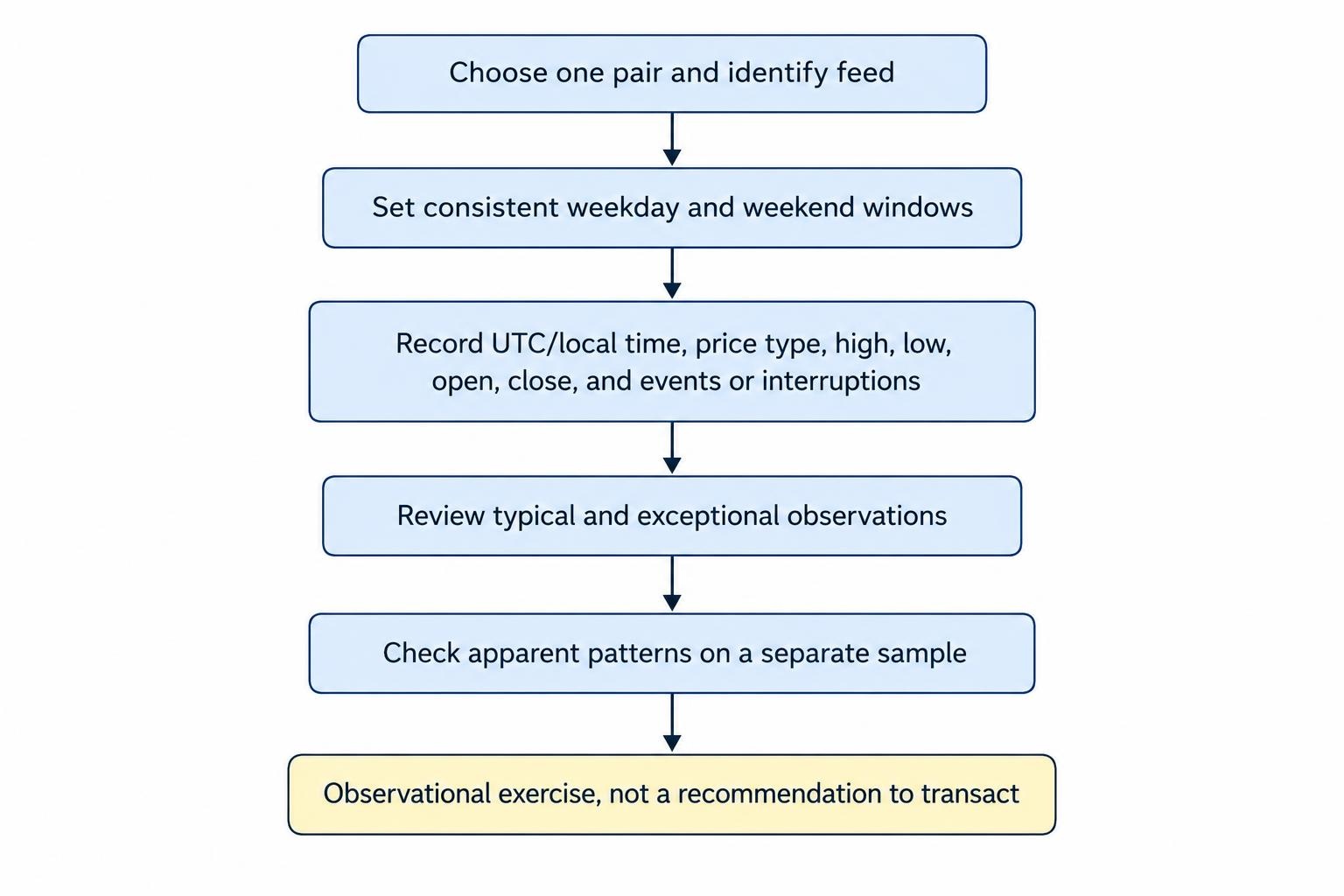
Choose one cryptocurrency pair and one identified data feed. Set observation windows before reviewing the results, including both weekday and weekend periods. Keep the duration consistent so that an unusually active five minute interval is not compared with an entire quiet afternoon.
Record a small set of useful fields:
- The date, UTC timestamp and local time zone.
- The pair, venue or index, and price type used.
- The opening price, closing price, high and low for each window.
- Any scheduled announcement, unexpected event or feed interruption.
- The hypothetical condition and expiry being assessed, if applicable.
A structured trading journal can keep these observations comparable. Label hindsight honestly. If an event was identified only after the price moved, do not record it as something known beforehand.
Review typical observations as well as the largest moves. A session average dominated by one exceptional event may not describe an ordinary day. Then check any apparent pattern on a later, separate sample rather than repeatedly adjusting the rule to fit the original results.
The useful question is not simply when cryptocurrency markets are open. It is whether the data, participation and price behaviour during a defined period support the claim being made. Twenty four hour access answers the scheduling question, it does not answer the forecasting question.
This article was last updated on: October 22, 2026