A foreign financial services licence, a private membership certificate and a company registration document are not interchangeable. Each answers a different question about a binary options provider. None should be treated as a general promise that an Australian customer can lawfully be served, recover a disputed withdrawal or receive compensation.
The useful question is not whether a broker displays an official looking badge. It is whether the named organisation has authority over the legal entity holding your account, for the product being offered, in the circumstances that apply to you.
Start With Australia’s Retail Binary Options Ban
ASIC’s prohibition on issuing and distributing binary options to retail clients took effect on 3 May 2021 and has been extended until 1 October 2031. The ASIC announcement extending the binary options ban confirms both dates. A foreign licence or private certificate does not override that restriction.
This changes the purpose of checking an overseas provider’s credentials. The exercise is not a search for a badge that makes the Australian retail prohibition disappear. It is a way to test claims, identify the contracting company and avoid mistaking a commercial membership for regulatory permission.
A provider accepting an Australian address, displaying Australian dollars or processing a deposit does not, by itself, establish that the offer complies with Australian requirements. Treat access to a platform and permission to supply its products as separate questions. The broader guide to binary options regulation in Australia covers the domestic framework.
Separate the Documents Before Assessing Them
Company registration is a common source of confusion. A registered company can exist without being authorised to provide the financial service being advertised. Moneysmart’s investment verification guidance expressly distinguishes company registration from financial services licensing and warns that a licence is not an ASIC endorsement or guarantee against loss.
Before examining a document’s appearance, put it in the right category:
| Credential presented | What to verify | What not to assume |
|---|---|---|
| Financial services licence | The licensee, current status, permitted activities and restrictions | That it covers every group company, product or country |
| Company registration certificate | The registered legal entity and company number | That incorporation authorises financial services |
| Private dispute resolution membership | The member entity, eligible complaints and membership terms | That membership is government supervision |
| Technical or management system certificate | The issuer, standard, assessed scope and validity dates | That the assessment establishes financial services permission |
| Award or commercial ranking | The selection process, assessment period and commercial relationships | That the award provides enforceable customer protection |
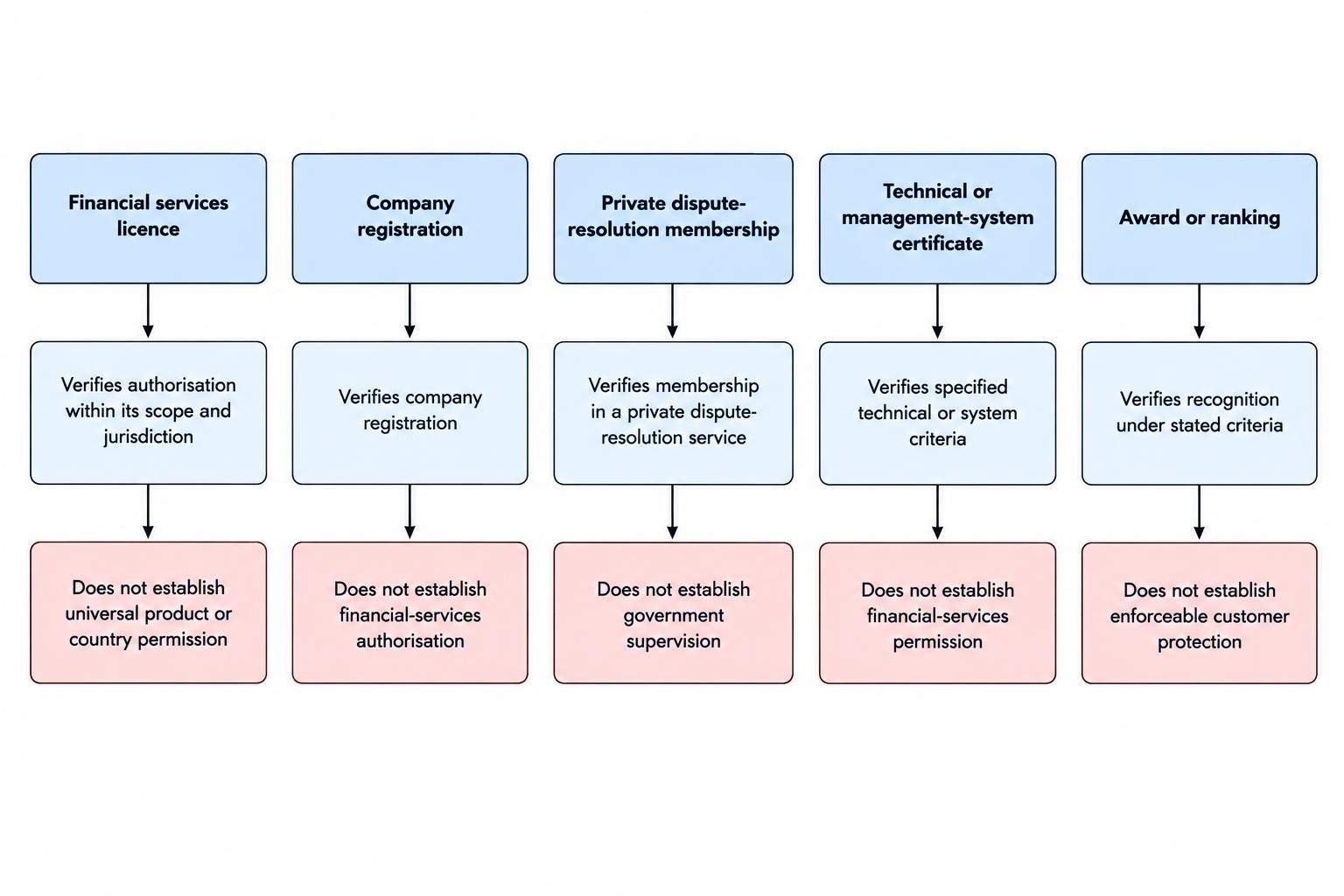
Authenticity is only the first test. A genuine certificate can still be irrelevant to the claim being made. The gold border does not expand its scope.
What a Foreign Regulatory Licence Actually Establishes
An overseas licence is not automatically an Australian financial services licence. A foreign business carrying on a financial services business in Australia generally needs an AFS licence or an applicable authorisation or exemption. ASIC Regulatory Guide 121 on doing financial services business in Australia addresses that framework, including circumstances in which exemptions may apply.
Keep three questions separate: whether the company is authorised overseas, whether its Australian activities meet Australian requirements, and whether the product can be supplied to the relevant customer category. A satisfactory answer to one does not settle the others.
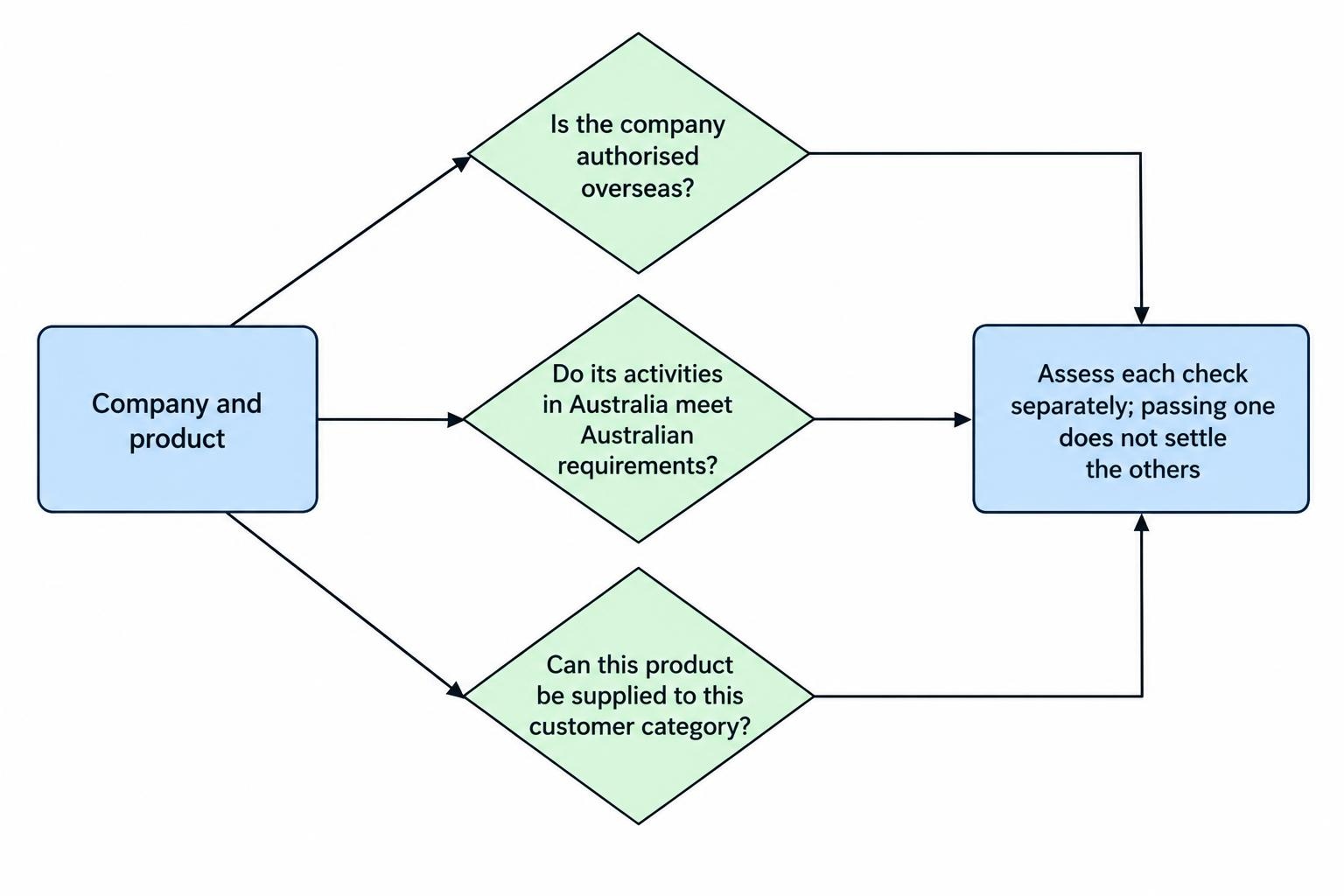
When reviewing a foreign licence, look beyond the regulator’s name. Establish which company holds it, which services the permission covers, whether it remains current and whether restrictions affect the proposed account. Do not accept “internationally regulated” as a substitute for those details.
If a provider relies on an exemption, ask it to identify the legal basis and explain why it applies to that entity, service and customer category. Do not infer retail permission from material discussing wholesale clients. Nor should a salesperson’s description of an account as “professional” settle its legal classification.
The separate guide to checking a broker’s licence covers register searches in more detail. Here, the central distinction is between evidence of overseas authorisation and evidence that the proposed Australian service is permitted.
A UK Licence Does Not Mean Retail Binary Options Permission
The UK provides a useful example. The FCA’s rules prohibit the retail marketing, distribution and sale of the binary or fixed outcome investments within their scope. These prohibitions appear in FCA Handbook COBS 22.4 on retail binary options, with the prohibition provisions effective from 2 April 2019.
A claim that a business is FCA authorised therefore does not establish that its retail binary options offer is permitted. Check the product and the permission together. An authentic regulatory reference can be attached to an offer that it does not authorise.
Match the Licence to the Company in Your Agreement
Consider a hypothetical trading group with two companies. Company A holds a financial services licence in one country. Company B operates another platform and appears in the customer agreement. The group’s homepage prominently displays Company A’s licence.
The verification question is whether Company A is actually responsible for the proposed account. Shared branding is not enough evidence. Before relying on the licence, establish the role of each entity and the basis on which any protection would extend to the contract with Company B.
Compare the legal name in the agreement with the name on the regulatory record, account opening confirmation and payment instructions. If the names differ, request a written explanation. A payment processor may have a separate role, but that role should be clear rather than left for the customer to guess.
Do the same check when terms change. If a provider asks you to accept a new contracting entity, reassess the credentials against that entity. Do not carry an earlier verification forward simply because the platform retains the same logo.
Private Certificates and Dispute Resolution Memberships
A private organisation may assess applicants, publish membership rules or offer complaint handling without being a statutory financial regulator. Those services should be evaluated on their own terms, not dismissed automatically or promoted as something they are not.
The Financial Commission illustrates the distinction. It operates an independent, non-governmental dispute resolution forum funded by broker membership dues. It expressly states that it is not a governmental regulatory body and is not licensed by a regulator. Its description of its dispute resolution role is narrower than a claim of government authorisation.
If a provider displays such a membership, ask what practical rights follow. Check the exact member entity, whether membership is current, whether your product and complaint fall within the scheme’s scope, and what deadlines apply. Request the rules rather than relying on a sales summary.
Also distinguish access to a complaint process from an assured payment. Ask what happens after a decision, whether the member must comply, and what remedy exists if it does not. These questions matter more than the size of the badge on the homepage.
Read Compensation Claims in Full
The Financial Commission’s compensation arrangements are conditional. Its fund is used when a member refuses to comply with a judgment issued by the organisation. It does not cover losses from self-directed trading or the entire client base of an insolvent member. Those restrictions appear in its compensation fund and dispute resolution FAQ.
Do not translate a headline compensation amount into “my account balance is insured”. Before relying on any scheme, establish the payment trigger, eligible claimant, covered entity, exclusions and applicable cap. Check whether the advertised amount concerns an individual claim, an individual customer or some other measure.
ISO Certificates and Technical Audits Have a Different Purpose
Certification and accreditation also need careful reading. Certification provides independent written assurance that a product, service or system meets stated requirements. Accreditation concerns recognition of a certification body’s competence. ISO develops standards but does not itself perform certification or issue certificates, as its guidance on certification and accreditation makes clear.
For a broker displaying an ISO related certificate, inspect the actual document. Identify the certification body, named organisation, standard, covered activities, locations and validity dates. Ask the issuer to confirm the document if the scope or status is unclear.
Then compare that scope with the claim being made. If an assessment concerns a management system, do not treat it as proof of financial services authorisation, withdrawal reliability or the fairness of every quoted price. Those are different questions.
Apply the same discipline to execution audits and platform checks. Ask what was tested, over what period, using which data and against which criteria. A narrow assessment deserves a narrow interpretation, even when the certificate itself is genuine.
Verify the Claim Without Trusting the Badge
A displayed licence number can be genuine while the person using it is not. Clone firms copy the names, addresses, reference numbers and contact details of authorised businesses. The FCA’s warning about clone firms describes these tactics and recommends matching contact details against independently obtained regulatory information.
Use a verification process that does not depend entirely on material supplied by the promoter:
- Start independently. Find the regulator or certificate issuer without using a link sent in a message or advertisement.
- Match the entity. Compare the full legal name and identifying number with the customer agreement.
- Check status and scope. Look for current permission, restrictions, expiry dates and the activities actually covered.
- Confirm through separate contact details. Use independently verified details to ask about an unfamiliar domain, account or representative.
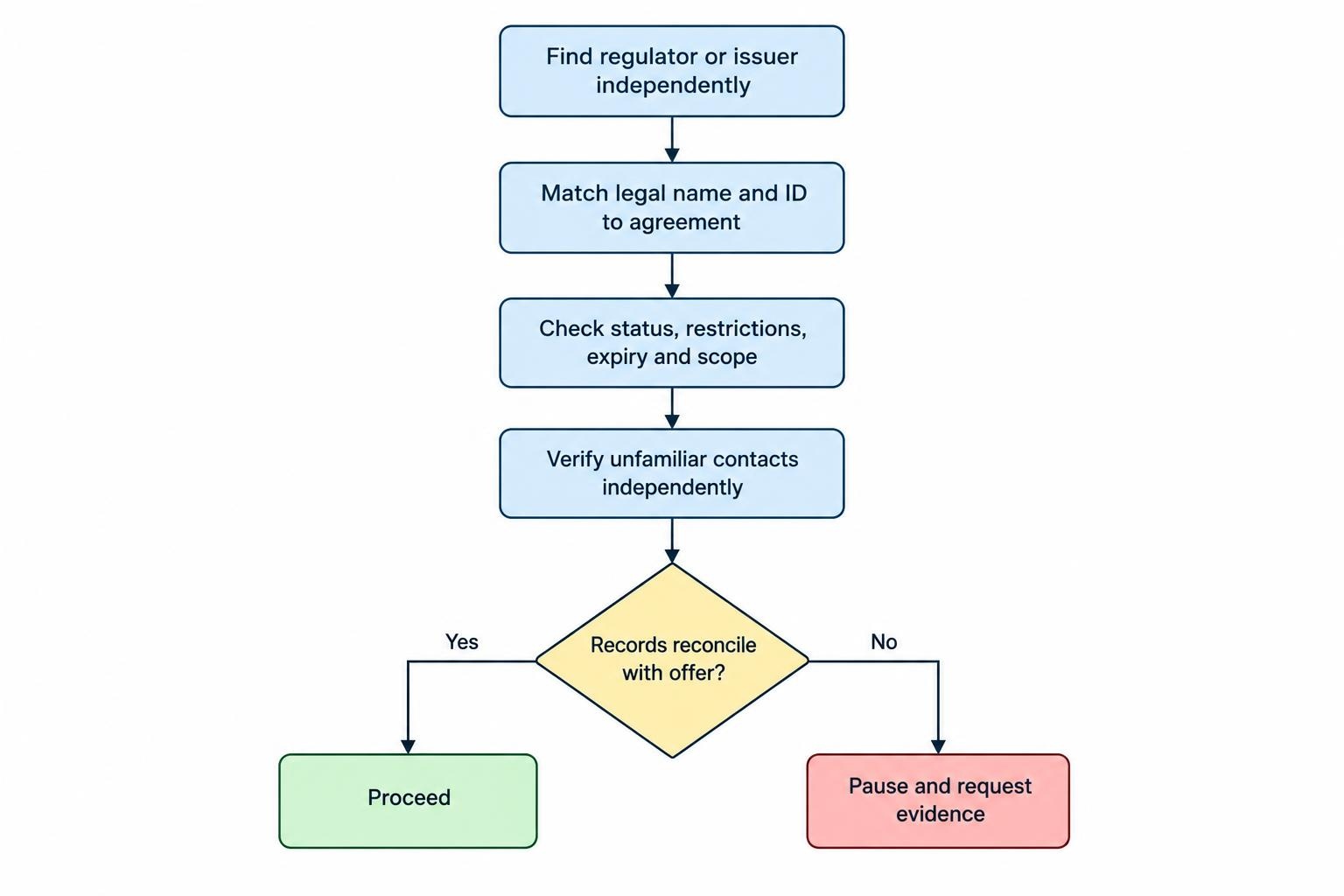
Save the results with the date checked. Retain the agreement and the version of the certificate being promoted. If a record cannot be reconciled with the offer, pause. A screenshot sent by the salesperson is not an independent answer to the discrepancy.
Check Money Protection and Complaint Rights Separately
Once a credential has been verified, assess the protections being claimed. Do not use “regulated”, “certified” and “protected” as if they describe the same arrangement.
For customer money, ask who receives it, which entity owes the account balance, where funds are held and what contractual terms govern their use. Request evidence for any segregation or insolvency protection claim. Do not assume a technical certificate or private membership answers those questions. The guide to client money and broker insolvency examines that separate issue.
For complaints, identify the route before a dispute arises. Ask which legal entity must respond, which external body could hear the matter, whether your complaint would be eligible and what time limits apply. Where Australian complaint rights are claimed, check those claims independently rather than treating a foreign certificate as evidence.
The distinction between a private scheme and an Australian complaint pathway matters. The guide to broker complaints and AFCA covers the domestic route. Keep copies of any written promises about complaint access alongside the account agreement.
When a Credential Cannot Be Verified
A missing record, unexplained entity mismatch or certificate with unclear scope is a reason to stop and ask for evidence. Do not send more money to resolve a documentation gap. Request the full legal name, permission number, relevant register record and written explanation of the protection being claimed.
If funds have already been transferred, preserve payment receipts, account statements, messages and the terms accepted. Contact the payment provider promptly about available options, and describe the facts accurately without assuming recovery is guaranteed.
The standard is straightforward: verify who issued the credential, what it covers and whether it applies to your contract. A foreign licence can be genuine yet insufficient for the proposed Australian service. A private certificate can be authentic yet provide much less protection than the advertisement suggests.
This article was last updated on: October 22, 2026