Bitcoin binary options pay a fixed amount when a stated condition about Bitcoin’s price is met. A typical contract asks whether BTC will finish above or below a strike price at a set expiry time. You are taking a position on that outcome, not buying Bitcoin.
Australian retail access is restricted. ASIC banned the issue and distribution of binary options to retail clients from 3 May 2021 and extended the ban until 1 October 2031. The ASIC announcement confirming the extension sets out the restriction. The examples below explain the contracts, rather than recommend an account or provider.
What a Bitcoin Binary Option Actually Tracks
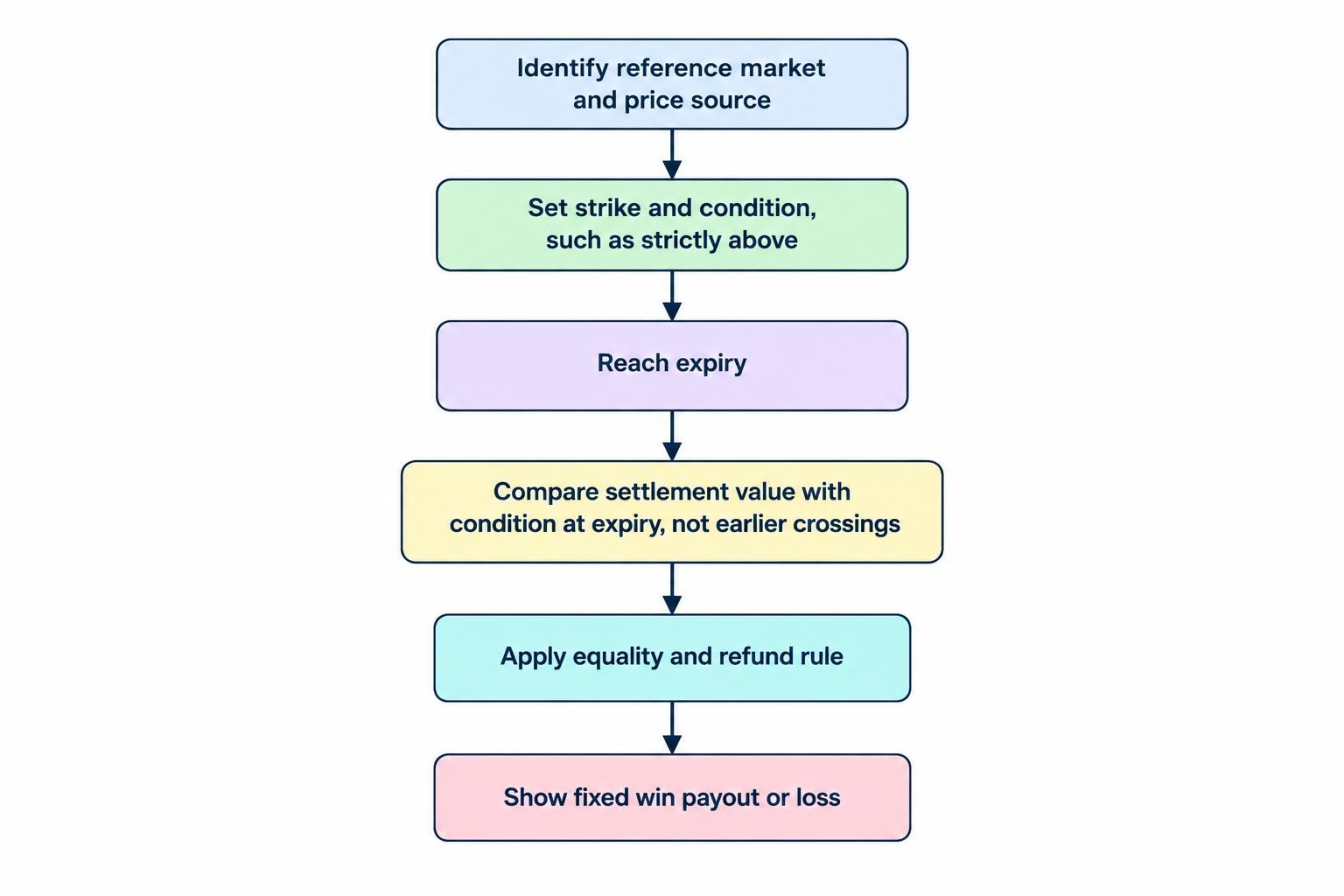
A Bitcoin binary option combines several terms: the reference market, strike price, expiry, settlement rule and payout. “Bitcoin will rise” is not a complete description. The contract must establish which Bitcoin price counts, what it must exceed and when the comparison happens.
For an above or below contract, the distance beyond the strike does not normally change the agreed payout. Finishing US$1 above the strike can produce the same return as finishing US$1,000 above it. Conversely, a large rise earlier in the contract does not secure a win if the settlement price finishes on the losing side.
Three things should remain separate: Bitcoin as the reference asset, the currency used to fund an account, and the currency in which the contract pays. Funding an account with BTC does not mean every contract tracks Bitcoin. A BTC/USD contract could also use a dollar account without delivering any Bitcoin to the holder.
This distinction applies across cryptocurrency binary options, but Bitcoin contracts still need their own pricing and settlement checks. A familiar asset name does not make the contract terms interchangeable.
A Worked Bitcoin Binary Options Example
Consider a hypothetical contract asking whether BTC/USD will be strictly above US$80,000 at 14:05 UTC. Assume a stake of A$100, an 85% net profit on a winning contract, and no refund if the condition fails. These figures illustrate the mechanics; they are not a current Bitcoin quote or an available offer.
| Settlement price | Outcome | Amount returned | Net result |
|---|---|---|---|
| US$80,000.01 | Condition met | A$185 | A$85 profit |
| US$80,000.00 | Condition not met | A$0 | A$100 loss |
| US$79,999.99 | Condition not met | A$0 | A$100 loss |
The winning return includes the original A$100 stake plus A$85 profit. Calling the entire A$185 “profit” would overstate the result.
The equality result follows this example’s strict “above” condition and no-refund rule. Another contract might return the stake when the settlement price equals the strike. Never assume that an unchanged displayed price produces a refund.
Suppose Bitcoin reaches US$80,600 before expiry, then settles at US$79,999.99. This contract loses despite spending time above the strike. It tests the price at expiry, not whether Bitcoin crossed the level earlier. A touch contract would require a different test.
Which Bitcoin Price Determines the Result?
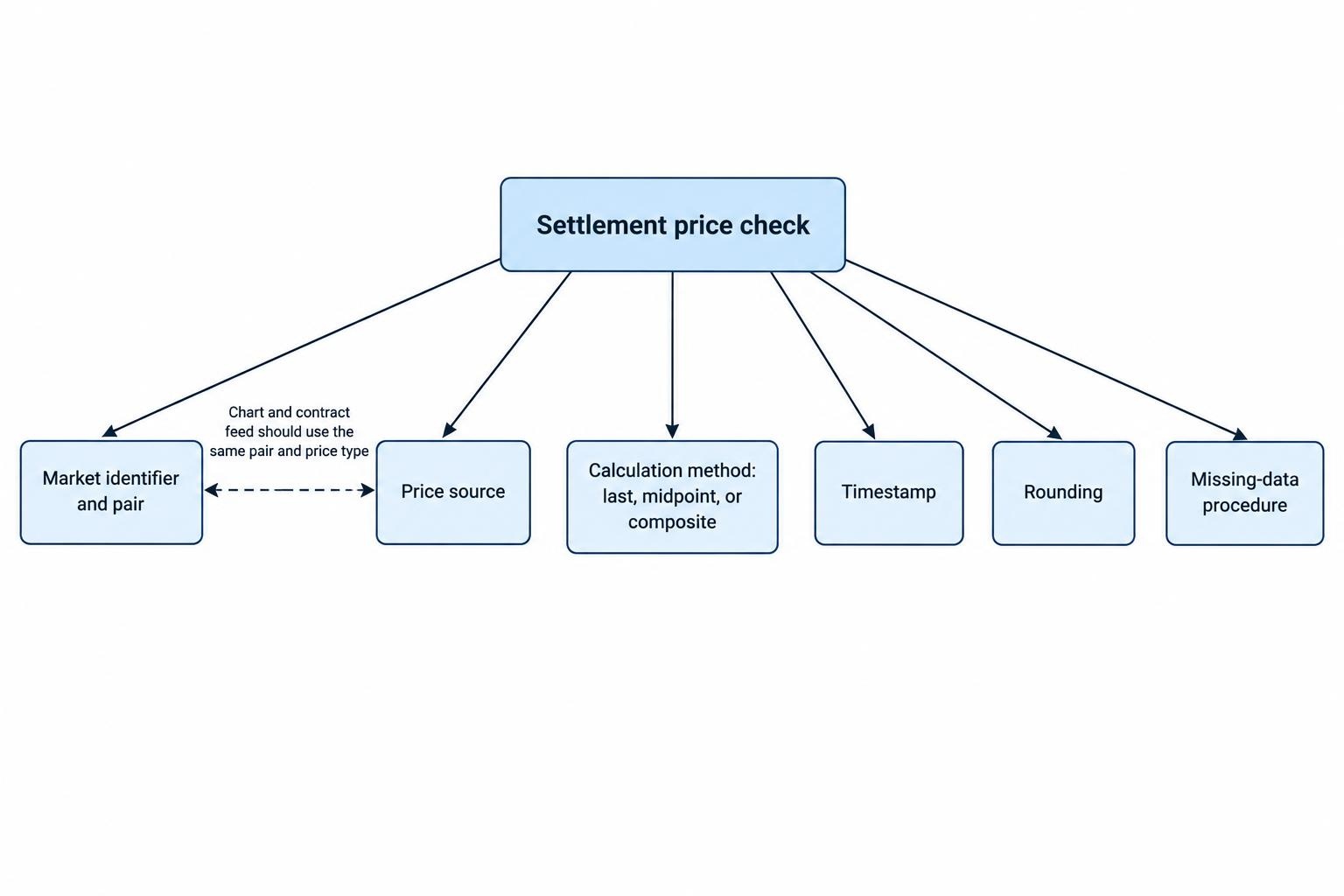
“The Bitcoin price” is too vague for settlement. A contract may reference an exchange market, a composite index or another stated calculation. Your analysis chart and the contract’s settlement feed must match closely enough for the comparison to mean anything.
BTC/USD is not the same quotation as BTC/USDT
BTC/USD expresses Bitcoin’s price in US dollars. BTC/USDT expresses it in units of the USDT stablecoin. These are different trading pairs, even when their displayed prices appear close.
A BTC/AUD chart introduces another currency relationship. A rise in Bitcoin’s Australian dollar price does not, by itself, establish whether a BTC/USD contract should finish above its strike. The Australian dollar’s movement against the US dollar also affects that comparison.
For a paper exercise, record the full market identifier, including the exchange or index name. Saving only “BTC” leaves too much unanswered when reviewing a result near the strike.
A live index and a daily reference rate serve different purposes
The CME CF Bitcoin Real Time Index, or BRTI, provides a real time US dollar Bitcoin price. The CME CF Bitcoin Reference Rate, or BRR, is a daily reference rate calculated from trading during a defined window. The CME explanation of Bitcoin reference prices shows why a live index and a daily settlement benchmark are not substitutes.
That does not establish which benchmark a binary options contract uses. A platform displaying a familiar benchmark name must still identify how that benchmark enters its contract terms. A logo beside a chart is not a settlement methodology.
Last price, midpoint and rounding can change a close result
A last traded price comes from a completed transaction. A midpoint sits between the best bid and offer. A composite can combine information from several venues. These calculations need not produce identical values at the same instant.
Display precision matters too. Two values can look equal after rounding while differing in the underlying data. A screenshot showing US$80,000 does not establish whether the unrounded settlement value was above or below that level.
The relevant checks are the price source, calculation method, timestamp, rounding rule and procedure for missing data. Our guide to price feeds and benchmarks covers those checks across markets. For Bitcoin, start by confirming that both charts refer to the same pair and price type.
The Payout Determines the Accuracy Needed
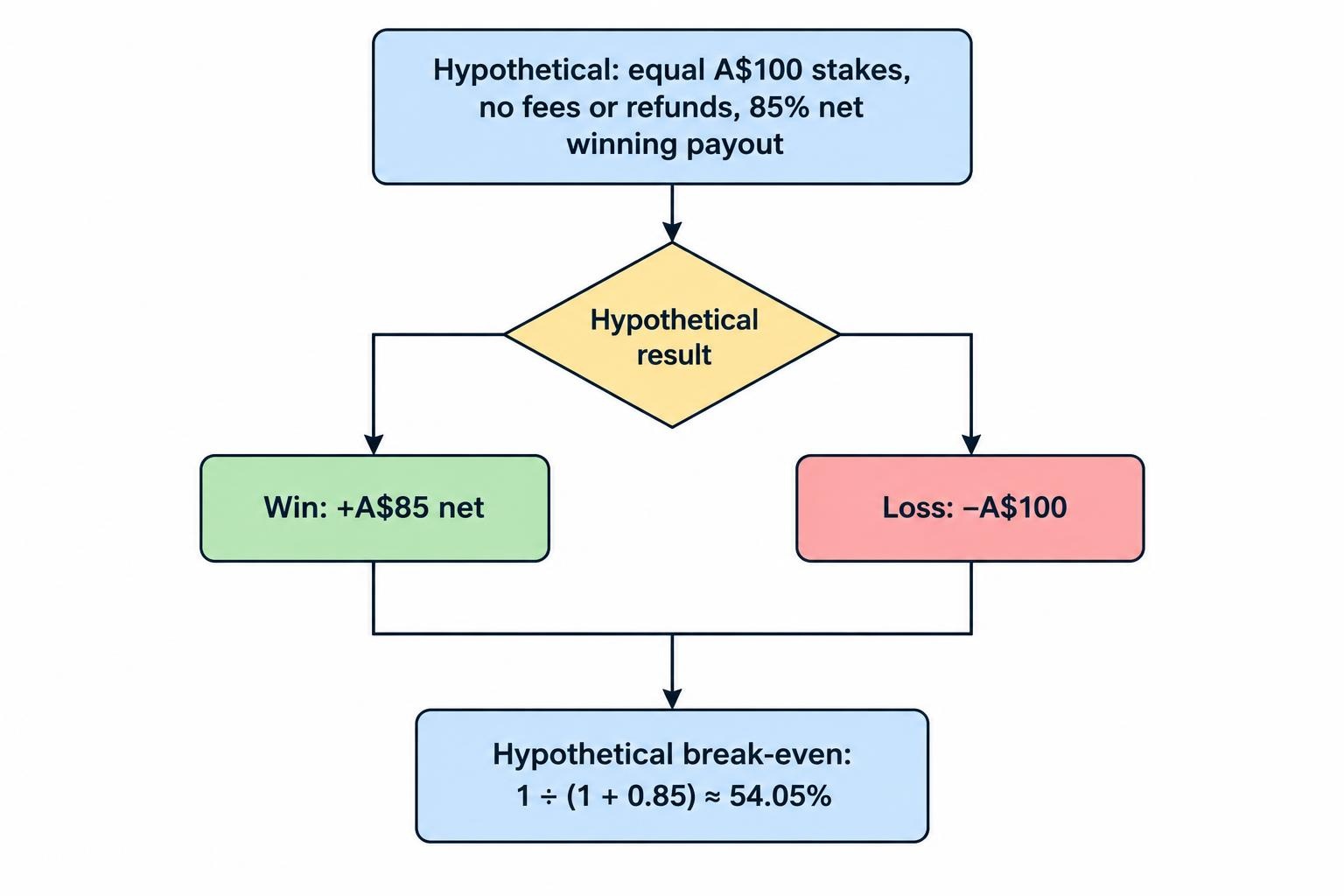
A fixed payout does not mean an even financial contest. In the example above, a loss costs A$100 but a win earns A$85. One win therefore does not fully recover one loss.
With equal stakes, no fees, no refunds and an unchanged 85% net winning payout, the break-even win rate is:
Break-even win rate = 1 ÷ (1 + 0.85) = approximately 54.05%.
At an 80% net winning payout, the threshold rises to approximately 55.56%. A lower payout demands greater accuracy, even if the Bitcoin setup looks identical.
Take 100 hypothetical A$100 contracts at an 85% net winning payout. Fifty wins generate A$4,250 profit, while fifty losses cost A$5,000. The net result is a A$750 loss before other costs. A direction forecast can be right half the time and still lose money under these terms.
These are calculations, not forecasts of achievable performance. The general relationship is covered in probability and expected value in binary options. For Bitcoin research, retain the payout available for each observation rather than applying the best advertised rate to every historical result.
Bitcoin Volatility Does Not Automatically Create an Advantage
Bitcoin’s price can move sharply over short periods. The Moneysmart guidance on crypto assets warns that crypto prices can fluctuate heavily and that investors should be prepared for losses.
That volatility has a different effect on a fixed payout contract than on owning Bitcoin. A much larger favourable move does not increase the agreed payout on an ordinary above or below contract. Yet a reversal before expiry can still turn a winning position into a full stake loss.
Nor does “more movement” prove that a direction signal has become more accurate. A research method needs to distinguish the size of price changes from its ability to identify which side of the strike will hold at expiry.
Match the forecast horizon to the expiry
A bullish view covering several months says little about the next five minutes. The expiry must match the question being tested. Otherwise, a long term argument becomes a short term guess with better vocabulary.
Very short expiries also leave less time between an observation and settlement. In a hypothetical one-minute contract, a five-second delay consumes a much larger share of the forecast horizon than it would in a one-hour contract. This is arithmetic, not proof that a longer contract is profitable or safer.
Bitcoin price information continues through weekends, but that does not establish that a particular provider offers contracts continuously. Separate the underlying market’s activity from the platform’s dealing hours. The related guide to cryptocurrency volatility and market hours examines that distinction without assuming every session behaves alike.
Risks That a Bitcoin Chart Cannot Show
A chart can help assess a price hypothesis. It cannot establish whether a provider holds customer funds properly, processes withdrawals or applies its published settlement terms.
The SEC and CFTC binary options fraud alert identifies complaints involving withheld funds, identity theft and software manipulation. These risks sit outside the accuracy of a Bitcoin forecast. A profitable result displayed in an account is not the same as money successfully withdrawn.
A real cryptocurrency deposit also does not prove that the platform has executed a genuine trade. It establishes that funds moved, not that the recipient’s trading records are reliable.
Keep any evaluation grounded in verifiable information: the legal entity, written contract terms, settlement records and withdrawal conditions. Treat guaranteed returns, pressure to deposit more and requests for remote access as reasons to stop, not obstacles to work around. No chart pattern can repair an unreliable counterparty.
Bitcoin Does Not Create an Exception to Australia’s Ban
Using cryptocurrency as the reference asset does not place an otherwise covered contract outside the Australian binary options restriction. The ASIC binary options instrument expressly includes cryptoassets within the assets that can determine a binary option’s condition.
The instrument also addresses offers received in Australia. An offshore address is therefore not, by itself, evidence that an offer falls outside Australian requirements.
For an Australian retail reader, the practical question is not which platform has the most attractive BTC payout. It is whether the product can lawfully be offered at all. A functioning registration page, cryptocurrency payment option or account approval does not answer that question.
Do not change your stated residence or accept an inappropriate client classification to obtain access. Those steps do not improve the economics of the contract and can create further problems.
How to Study Bitcoin Contracts Without Funding an Account
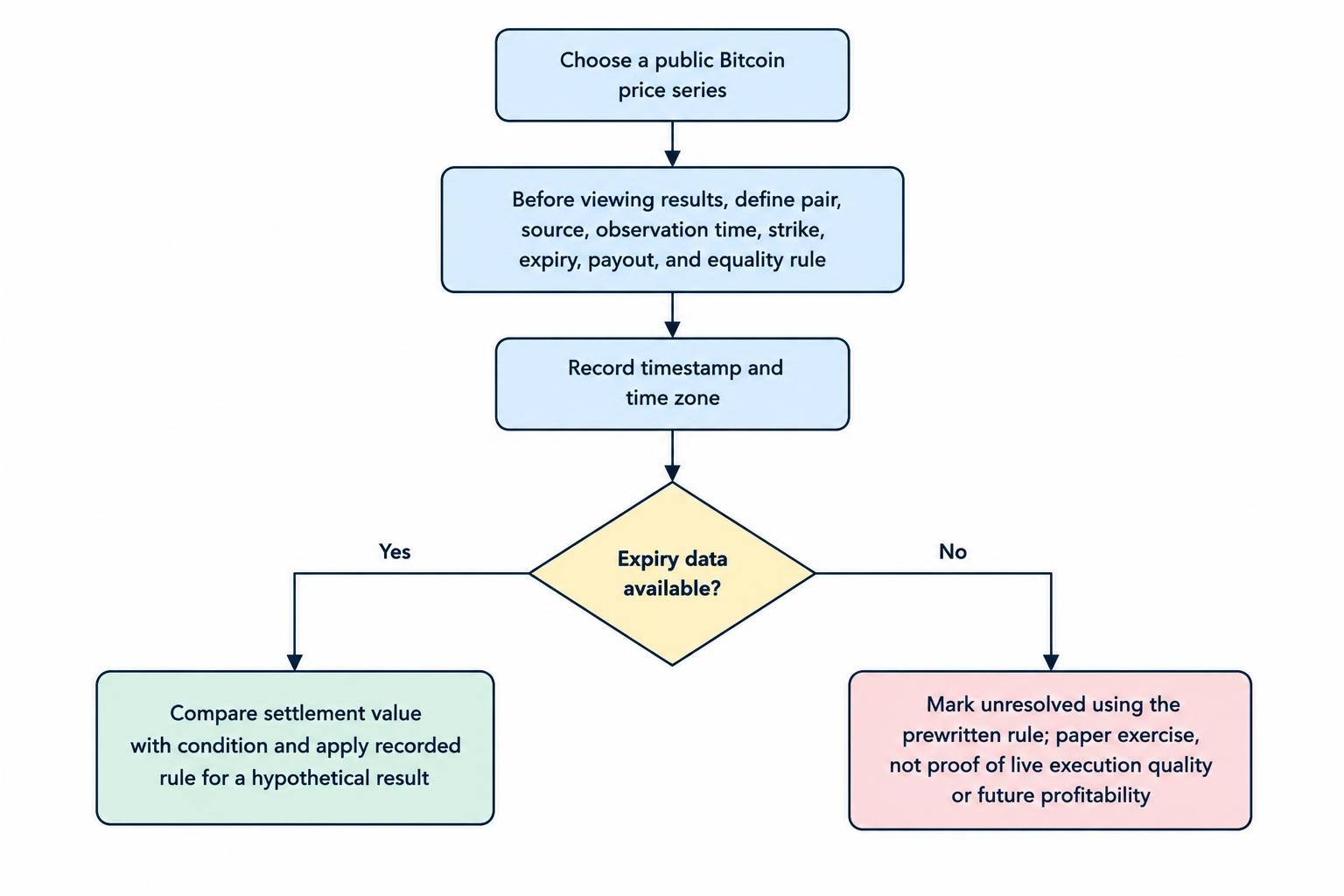
A spreadsheet can test contract mechanics without a deposit. Choose a public Bitcoin price series and define the pair, observation time, hypothetical strike, expiry and payout before looking at the outcome. This keeps the exercise separate from a provider’s account process.
For each observation, retain:
- The exchange or index, trading pair and price calculation.
- The timestamp, time zone, strike and expiry.
- The assumed payout, equality rule and missing-data treatment.
- The settlement value and resulting hypothetical profit or loss.
Do not silently remove awkward observations. If the feed is missing at expiry, mark the result unresolved under a rule written beforehand. If the price equals the strike, apply the recorded equality rule rather than choosing the more favourable outcome.
The paper trading guide provides a broader framework for this work. A simulation can test whether a method has been defined consistently, but it cannot prove live execution quality, withdrawal reliability or future profitability.
Bitcoin binary options reduce a price question to a fixed contractual outcome. Evaluating them requires more than a view on Bitcoin: the correct feed, exact expiry, settlement wording and payout arithmetic all matter. For Australian retail clients, those mechanics must be considered alongside the restriction on their issue and distribution.
This article was last updated on: October 22, 2026