Paper trading binary options means recording hypothetical trades and calculating their results without placing funded orders. A spreadsheet, a timestamped price feed and a written set of rules are enough to build a useful exercise. The purpose is not to produce an impressive imaginary balance. It is to test whether decisions were made before the outcome, whether settlement can be reproduced and whether the payout arithmetic supports the result.
For Australian readers, this is an educational exercise, not preparation for opening a retail binary options account. ASIC’s prohibition on issuing and distributing binary options to retail clients took effect on 3 May 2021 and has been extended until 1 October 2031. The ASIC announcement extending the binary options ban sets out that restriction.
What Paper Trading Can Test
A useful paper record answers a narrow question: what would this written decision rule have produced under these stated assumptions? Those assumptions include the entry price, expiry, payout, settlement method and treatment of missing data.
Start with a simple higher or lower exercise. Record whether a chosen reference price will finish above or below a recorded strike at a fixed expiry. Leave touch, range and other path-dependent structures for separate studies; their outcomes require more than comparing two endpoint prices.
Paper trading and a demo account overlap, but they are not identical. A manual record gives you control over the assumptions and an opportunity to audit every result. A simulator may handle the balance and settlement automatically. Neither format makes its assumptions correct simply because the balance updates neatly. The separate guide to binary options demo accounts covers the account-based approach.
Keep historical replay separate from decisions made as prices arrive. If you inspect an old chart and then choose an entry, label it as historical analysis. Do not mix it into a record intended to show what you decided without knowing the outcome.
Define the Exercise Before Recording Trades
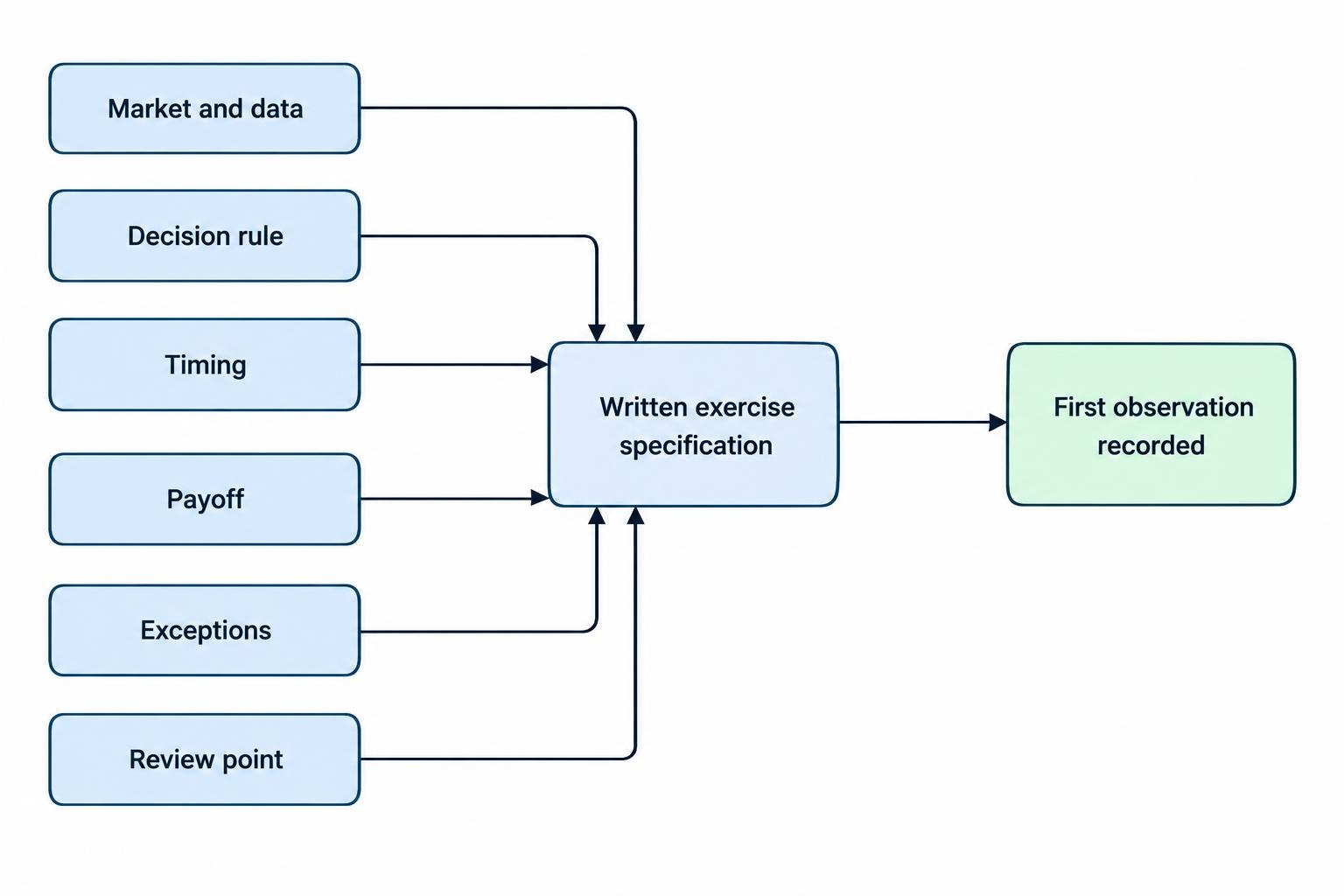
Write a short specification before the first entry. Another person should be able to use it to classify the same observation without asking what you meant.
- Market and data: Name the instrument, price source and quote type.
- Decision rule: State the exact conditions that permit a higher or lower prediction.
- Timing: Define the observation window, entry convention and expiry.
- Payoff: Set the hypothetical stake, winning profit and losing amount.
- Exceptions: Decide how to handle ties, stale quotes, missed entries and missing data.
- Review point: Choose when the batch ends and when changes may be considered.
Use Observable Rules
“Enter when the market looks strong” leaves too much room for interpretation. A testable rule might require a completed observation to meet a stated condition, followed by an entry at the next eligible timestamped quote. The rule need not be complicated. It needs to be clear enough that a disappointing result cannot change its meaning.
Also define when no entry is allowed. You might exclude observations outside a chosen session, signals received after a deadline or periods when the feed is stale. Record these exclusions as they happen rather than deciding later that certain losing entries should never have counted.
Set the Settlement Convention
For a standalone simulation, one possible convention is to use the last quote timestamped at or before expiry, provided it is no older than a predefined tolerance. That is an exercise rule, not a claim about how any commercial contract settles.
Specify what happens when the settlement price equals the strike. You could assume a refunded stake, but label that assumption. Do not treat it as universal. The guide to binary options settlement and ties covers why the comparison operator and contract wording matter.
If your data cannot resolve the outcome, mark the observation unresolved. A rounded chart label is not evidence that two underlying prices were exactly equal.
Record Decisions Before the Outcome Is Known
The most valuable part of paper trading is the record created at the decision time. Enter the direction, strike, expiry and reasoning before settlement. Save a timestamped screenshot or another contemporaneous record where practical.
Separate three moments: when the signal appeared, when you recorded your decision and which quote became the hypothetical entry. If your method requires waiting until an observation finishes, do not assign yourself an earlier price from inside it. That price was not available under your rule.
Use a fixed entry convention throughout the batch. For example, record the first eligible quote after the decision timestamp. Do not alternate between the signal price, the next quote and whichever chart price produces the better outcome.
Missed decisions belong in the record too. Note that the signal occurred and that no valid entry was recorded. Adding a missed winner after expiry creates a different exercise: one in which you already know the answer.
A Compact Paper Trading Ledger
Keep the ledger manageable, but retain enough detail to reconstruct each observation.
| Field | What to record |
|---|---|
| Observation ID | A permanent identifier that does not change after review |
| Rule version | The written method used for that batch |
| Instrument and feed | The market, data source and quote type |
| Decision and entry times | Timestamps using one stated time zone |
| Direction and strike | Higher or lower, plus the hypothetical entry level |
| Expiry and settlement | The scheduled expiry, observed price and supporting timestamp |
| Stake and payout assumption | The amount at risk and net profit payable on a win |
| Outcome and balance | Win, loss, tie or unresolved, with the resulting balance |
| Process notes | Rule breaches, data problems and evidence saved |
Keep original entries intact. If you correct a transcription error, preserve the previous value and explain the amendment. Otherwise, routine housekeeping can become accidental result editing. A structured trading journal can hold the ledger and review notes without turning every observation into an essay.
A Worked Paper Trade
The following figures are invented solely to demonstrate the accounting. They are not historical quotes or an available trading offer.
Suppose your exercise starts with a hypothetical A$500 balance and uses a fixed A$10 stake. A successful prediction earns A$8 net profit, described here as an 80% net payout. An unsuccessful prediction loses A$10. An exact tie refunds the stake under the exercise’s written rule.
At 10:00:00 UTC, you record a higher prediction on EUR/USD with a hypothetical strike of 1.08000. The scheduled expiry is 10:05:00 UTC. Under your settlement convention, the eligible expiry quote is 1.08012.
The settlement price exceeds the strike, so the observation is a win. The A$10 stake is returned with A$8 profit, taking the hypothetical balance to A$508. Do not record an A$18 profit: that figure includes your own returned stake.
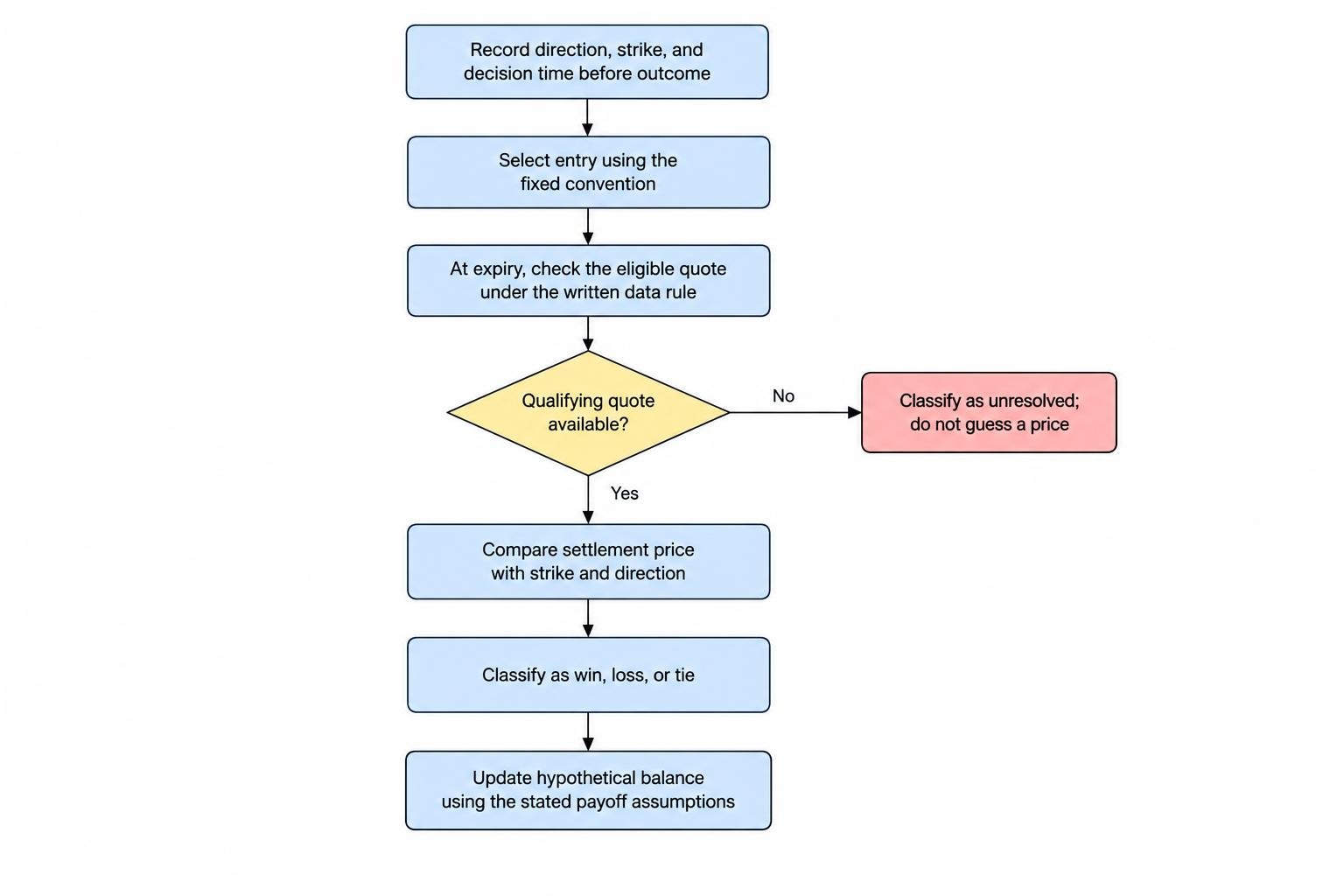
If the eligible settlement quote were 1.07998, the result would instead be a loss and the balance would fall to A$490. If the feed failed near expiry and no quote met your data rule, record an unresolved observation rather than choosing a convenient nearby price.
Keep unresolved stakes separate until the review. Show how much of the batch remains unsettled; do not present the settled balance as though every observation has been resolved.
Measure the Result Beyond the Win Rate
Winning more often than losing does not automatically produce a profitable paper record. The winning profit must be compared with the amount lost on an unsuccessful prediction.
Under the A$10 stake and A$8 winning-profit assumptions, the break-even win rate is:
A$10 ÷ (A$10 + A$8) = 55.56%
This calculation assumes only wins and losses, a constant payout and no other costs. At a 50% win rate, the expected result is an A$1 loss per observation: half of A$8 minus half of A$10. The guide to probability and expected value in binary options develops the relationship between accuracy and payoff.
Consider a hypothetical batch of 100 settled observations: 58 wins and 42 losses. At A$8 profit per win, the winning observations produce A$464. The losses cost A$420, leaving A$44 net profit.
Now keep the same outcomes but reduce the assumed winning profit to A$6. The result becomes A$348 minus A$420, or a loss of A$72. The predictions have not changed. The economics have.
Where no genuine payout is observable, describe the rate as a modelling assumption. Test several rates rather than selecting the one that makes the record profitable. If payouts vary within your model, calculate each observation separately instead of applying one rate to the whole batch.
Review the Path, Not Just the Ending Balance
Record the largest fall from a previous balance peak, the longest losing sequence and the number of rule breaches. Keep stake size unchanged during the initial exercise so that changes in the balance are easier to trace to outcomes rather than position sizing.
Also examine how much the result depends on a few observations. In the 80% payout example, changing one win into a loss reduces the result by A$18. Five such changes would turn the A$44 profit into an A$46 loss.
That sensitivity does not establish whether the method works. It shows why a modest positive balance deserves scrutiny rather than celebration.
Keep Data Problems Separate From Prediction Errors
Distinguish a wrong prediction from an observation that cannot be settled reliably. These are different findings and should remain visible in the report.
Use one stated reference series for entry and expiry. Record whether it represents bid, ask, midpoint or last traded prices, where that information is available. Do not silently substitute another chart when the original feed produces an inconvenient result. The separate guide to price feeds and benchmarks covers the reference-price questions behind this choice.
A chart can support an educational comparison without proving what an actual contract would have accepted or paid. Label the result accordingly: “hypothetical outcome using the stated reference feed” is more accurate than “trade that would have won”.
Report unresolved observations alongside settled ones. As a sensitivity check, calculate what would happen if every unresolved observation were a loss, then if every one were a win. A wide difference shows that the missing information matters. It does not justify choosing either extreme as the actual result.
Keep rule violations visible as well. You may calculate a separate rule-compliant subset, but retain the complete chronological record. Removing mistakes can make the method look easier to follow than your own exercise demonstrates.
What Paper Trading Cannot Establish
Simulated performance does not reproduce financial risk or fully represent the difficulty of following a method through actual losses. The NFA notice on hypothetical performance identifies those weaknesses, along with hindsight and imperfect treatment of market conditions. That notice concerns US regulated promotional material; it is not an Australian binary options permission or approval.
A paper ledger also provides no evidence that a provider would accept an order, honour a displayed price or process a withdrawal. Those events have not occurred in the exercise. Accurate spreadsheet arithmetic cannot fill that evidence gap.
Do not reset the balance after an uncomfortable losing sequence. If you start a new exercise, preserve the old one and state why the new batch exists. A reset button is not a risk policy.
The same applies to rule changes. Adjusting the method after reviewing outcomes creates a revised hypothesis, not a repaired track record. Give it a new version number and evaluate it on observations that were not used to choose the change.
Finish With an Audit, Not a Deposit Target
Choose the review point before starting. A first batch might contain 100 eligible observations spread across several sessions, but treat that as an administrative milestone, not proof of profitability or a statistically sufficient sample.
At the review, check whether entries were recorded on time, whether settlement can be reproduced, whether the balance includes every loss and whether the result survives less generous payout assumptions. Explain unresolved observations and rule breaches before interpreting the final number.
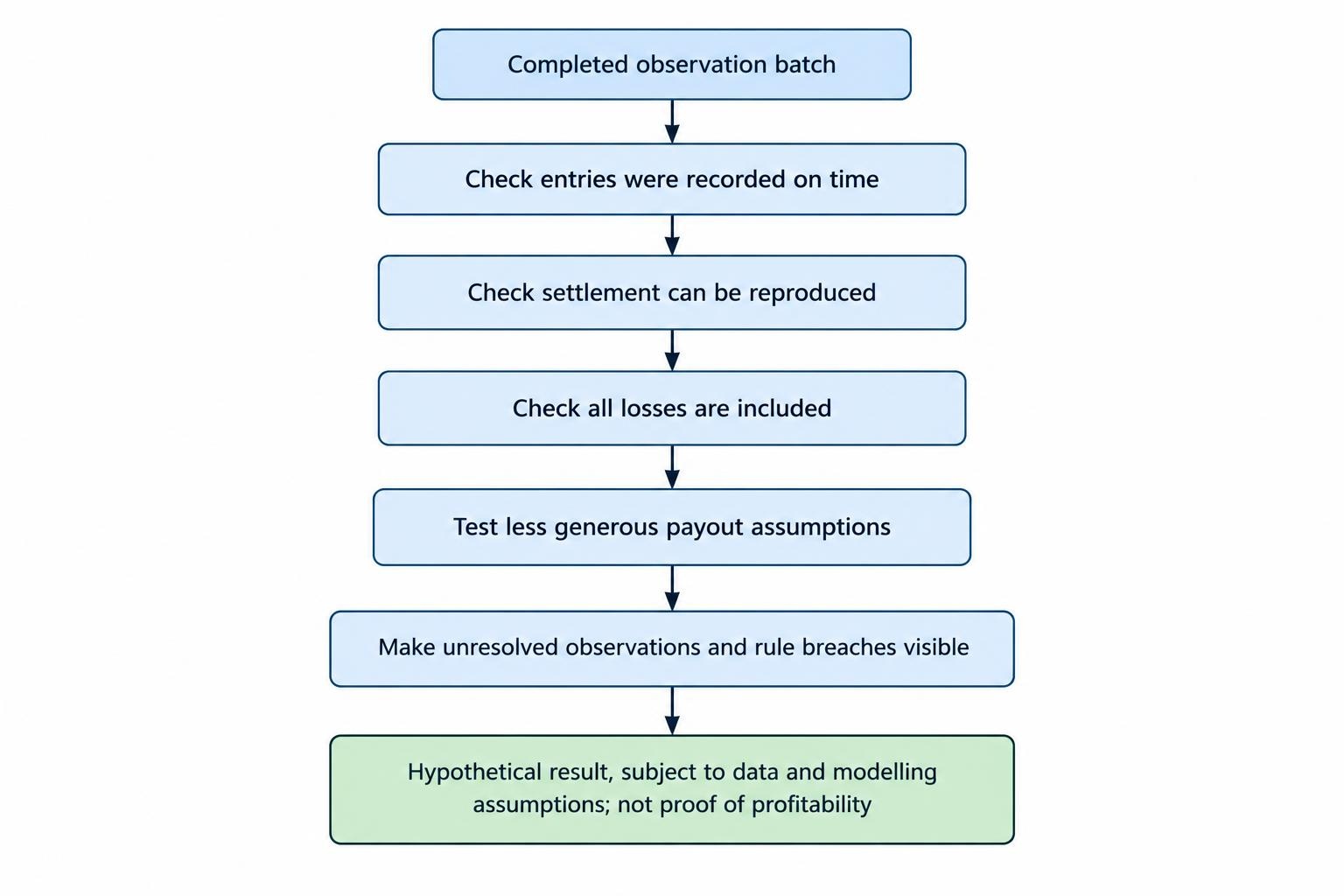
If the method remains worth studying, freeze its rules for another fresh batch. A written practice plan can define the observation schedule, review date and recordkeeping requirements without making profit the only objective.
The useful output is an auditable account of decisions and assumptions. A negative result can identify a failed idea before any funded order exists. A positive result remains hypothetical, subject to its data and modelling choices, and does not change the Australian retail prohibition.
This article was last updated on: October 22, 2026