A market hours tool should answer three questions: is the underlying market scheduled to trade, what time does that session fall in your location, and does the proposed expiry stay inside the relevant pricing window? A green “open” label is not enough if it refers to a different instrument or ignores a holiday.
This page provides a manual market hours checker, with reference times, Australian conversions and a worksheet. It does not display live exchange status or calculate countdowns. Use it for research and paper trading. ASIC’s binary options product intervention order bans the issue and distribution of binary options to retail clients in Australia until 1 October 2031.
How to Use the Market Hours Checker
Start with the instrument, not the city. “New York is open” tells you little unless you know whether the reference is a share, a cash index, an index futures contract or a currency pair. Those markets do not share one timetable.
- Choose a date and local city. Include the year. Use Sydney, Brisbane or Perth rather than the loose label “Australian time”.
- Identify the underlying reference. Record the exchange, symbol and price type. A cash index and its futures contract need separate checks.
- Apply the dated calendar. Check holidays, shortened sessions, scheduled breaks and any exchange notices that override normal hours.
- Compare the whole observation period. Check the intended start and expiry, not just whether the market is open at entry.
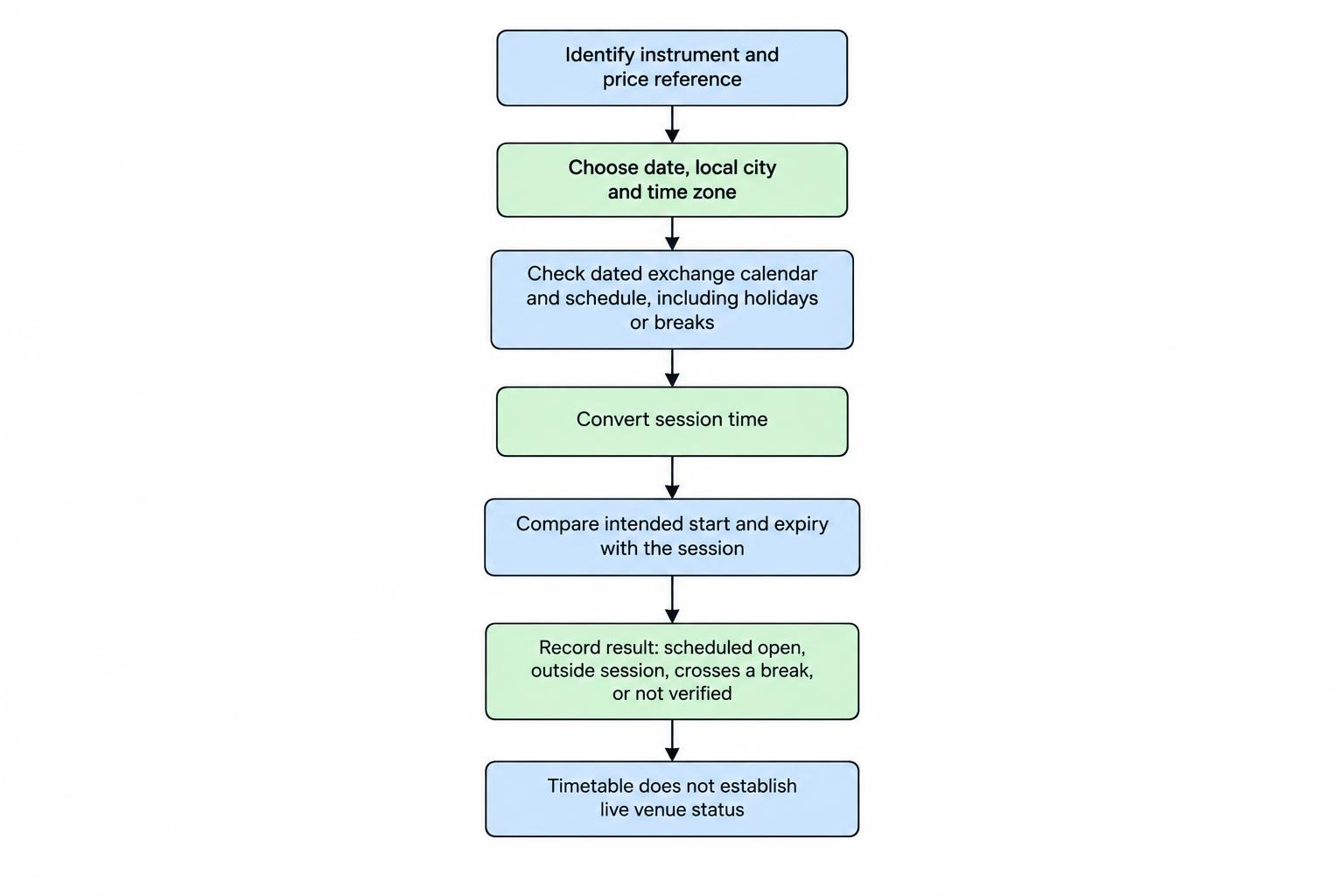
Record the result as “scheduled open”, “outside normal session”, “auction or break”, or “not verified”. Reserve “confirmed open” for a check against current venue status and a current price feed. A published timetable cannot detect an unexpected interruption.
The accompanying binary options trading hours guide covers the differences between underlying market sessions and contract availability. Here, the purpose is to turn those differences into a repeatable timing check.
ASX Cash Market Hours
The ASX cash market uses Sydney time and separates auctions from continuous trading. The current ASX equity market phase schedule places the opening auction in a randomised window beginning at 09:59:00. Continuous trading begins in a randomised window from 09:59:45 and ends at 16:00. The closing auction follows, with its randomised start from 16:10.
For a rough diary entry, “about 10:00 to 16:00 Sydney time” is useful. For a checker handling observations around the opening or closing seconds, it is too coarse. Record the auction and continuous session separately rather than treating everything before the final closing price as ordinary trading.
Apply this distinction to a paper exercise near the close. An observation beginning at 15:58 and ending at 16:03 crosses out of continuous trading. Do not label the entire five minutes “normal session” simply because its first price arrived before 16:00.
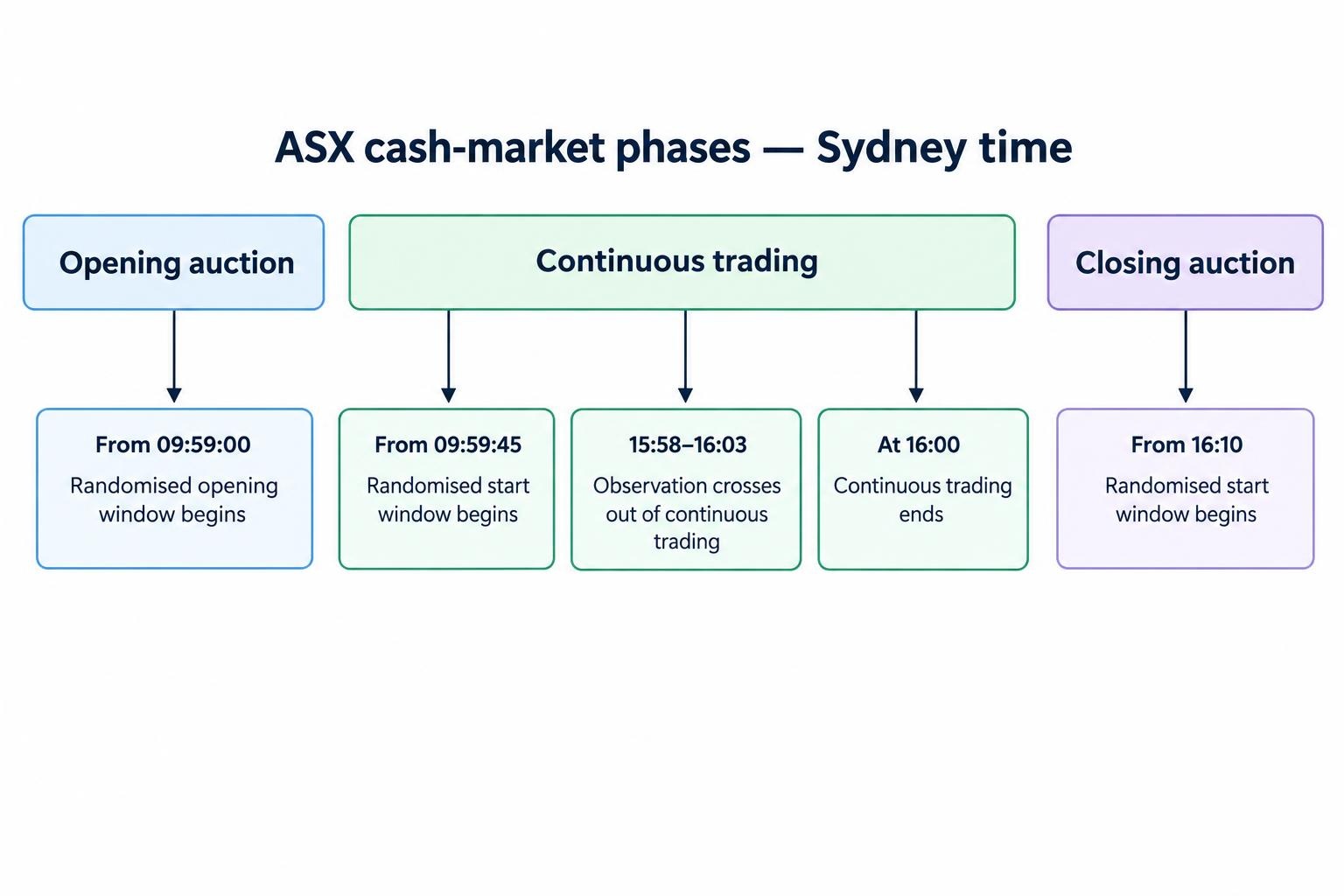
These are cash market reference hours. Do not copy them into an ASX 200 futures schedule or assume that a platform’s “Australia 200” label identifies the same pricing window.
US Share Market Hours in Sydney Time
The NYSE core equity session runs from 09:30 to 16:00 Eastern Time on normal trading days. Its Sydney equivalent changes because New York and Sydney adjust their clocks on different dates. The following conversions apply to that core session, not every US trading venue or extended session.
| Clock combination | Sydney opening | Sydney closing |
|---|---|---|
| New York EST; Sydney AEDT | 01:30 the following day | 08:00 the following day |
| New York EDT; Sydney AEST | 23:30 the same day | 06:00 the following day |
| New York EDT; Sydney AEDT | 00:30 the following day | 07:00 the following day |
“Same day” and “following day” refer to the New York session date. Under the second row, Monday’s New York session begins on Monday night in Sydney and finishes on Tuesday morning. Under the other rows, both Sydney timestamps fall on Tuesday.
Keep both dates in the worksheet. Writing only “Monday session” leaves room for an avoidable calendar error, especially when checking a US holiday from Australia.
Daylight Saving: Check the Date Before the Offset
The RBA’s 2026 daylight saving calendar records the Australian clock changes on 5 April and 4 October, and the US changes on 8 March and 1 November. Queensland, Western Australia and the Northern Territory do not observe daylight saving. A saved Sydney conversion therefore should not be reused for Brisbane throughout the year.
The practical trap is the changeover period. From 4 October until the US change on 1 November 2026, Sydney and New York both observe daylight time. The NYSE core session consequently converts to 00:30–07:00 Sydney time. After the US change, it converts to 01:30–08:00 Sydney time.
For a digital calendar or spreadsheet, select named city time zones where available rather than fixing a permanent hour difference. Also display the offset beside the converted time when checking an unfamiliar date. That gives you something to audit if two clocks disagree.
Do not “correct” the exchange’s published opening time to compensate for daylight saving. Keep 09:30 New York time as the source value, then convert it for the chosen date. Otherwise, it is easy to apply the adjustment twice. The clocks already create enough paperwork.
Forex Sessions Are Not Exchange Opening Bells
Spot foreign exchange has no single exchange opening auction. The Australian Foreign Exchange Committee’s trading hours guidance states that there are no set daily trading hours and that the market can operate 24 hours a day. Its normal trading week begins at 05:00 Sydney time on Monday and ends at 17:00 New York time on Friday.
Treat labels such as Sydney, Tokyo, London and New York as dealing session references, not universal permissions to trade. A session clock does not establish that a particular feed is available or that a contract using that feed accepts entries throughout the same period.
For a forex research worksheet, record the currency pair, observation window and feed availability separately. If studying overlapping sessions, convert both windows for the same date. Do not combine a London window saved in winter with a New York window saved in summer and call the result an overlap.
Futures and Cryptocurrency Need Separate Checks
Commodity and index futures require a product level schedule. Check the contract symbol, trading platform, breaks and holiday exceptions rather than borrowing the cash market’s timetable. CME Group’s trading hours and holiday schedules separate products and platforms, with times stated in Central Time unless noted otherwise. Read the time zone heading before converting any row.
A break inside a long session matters just as much as the final close. If an observation crosses a maintenance window, mark it as crossing a break rather than presenting the whole interval as uninterrupted trading. Keep the product’s trading date separate from your local calendar date where necessary.
For cryptocurrency research, check the chosen venue and price feed rather than substituting a general “24/7” label. Even where the underlying market supports continuous dealing, that does not establish uninterrupted data delivery or continuous availability of a separate derivative contract.
Apply Holidays and Early Closes Before Calculating Time Remaining
A weekday rule is only the first filter. The NYSE holiday and early closing calendar lists 26 November 2026 as closed for Thanksgiving and a 13:00 Eastern Time early close on 27 November 2026. A checker using the ordinary 16:00 close would overstate the remaining core session by three hours on that Friday.
With New York on EST and Sydney on AEDT, that 13:00 close converts to 05:00 Sydney time on Saturday, 28 November 2026. A paper observation scheduled for 06:00 Sydney time would therefore fall after the core close, even though it sits inside the normal overnight window.
Use the exchange calendar for the market being checked. An Australian public holiday is not, by itself, a reason to mark a US exchange closed. Keep settlement holidays separate from trading closures too.
Only calculate “time remaining” after applying these exceptions. Subtracting the current time from the wrong closing time produces a precise answer to the wrong question.
Check Expiry Against the Right Price Feed
Market hours establish when a reference market is scheduled to operate. They do not determine a binary contract’s entry cutoff, expiry or settlement method. For any historical or hypothetical contract exercise, read those fields separately. Do not infer them from the chart’s final visible candle.
Record whether the reference is a cash price, futures price, index value or another quoted benchmark. The price feeds and benchmarks guide covers that identification step. A familiar asset name is not enough to establish that two charts represent the same series.
Keep three timestamps distinct: the latest permitted entry, the expiry or observation time, and the time the result is posted. A result appearing after a market closes does not, on its own, show which earlier price determined it.
If the reference or timing rule cannot be established, mark the exercise “not verified”. Do not fill the gap with an assumption simply to complete the worksheet.
Market Hours Check Worksheet
Use one record for each market and observation date. The example below checks the NYSE core session on its 27 November 2026 early closing day. It is a calendar example, not a live status report.
| Field | Example entry |
|---|---|
| Reference market | NYSE core equity session |
| Exchange session date | 27 November 2026 |
| Local viewing zone | Sydney, AEDT |
| Calendar exception | Early close at 13:00 EST |
| Converted session | 01:30–05:00 Sydney time, 28 November 2026 |
| Hypothetical observation | 04:30–04:45 Sydney time, 28 November 2026 |
| Schedule result | Inside the scheduled core session |
| Still to verify | Current venue status, price feed and any contract timing rules |
Change the hypothetical expiry to 05:15 and the schedule result changes: the observation now crosses the early close. That is the useful output of a market hours check. It identifies a timing conflict without making a prediction about price direction or profitability.
Save the exchange calendar, conversion and verification time alongside the exercise in a trading journal. Keep the original record if you later correct an offset. That makes a timing mistake visible instead of allowing it to disappear into the results.
A sound check ends with a dated, instrument level answer: scheduled open, outside session, crossing a break, or not verified. None of those labels is a trading signal. Their job is narrower: to stop an incorrect clock, calendar or market reference from contaminating the analysis.
This article was last updated on: October 22, 2026