For Australian retail clients, the practical answer to Quotex vs Pocket Option is neither for live binary options trading. ASIC prohibits the issue and distribution of binary options to retail clients, with the order extended until 1 October 2031. A platform accepting a registration or displaying a deposit button does not override ASIC’s binary options product intervention order.
The platforms can still be compared as products. That comparison needs to separate interface features, advertised payouts and account access from regulatory protection. A convenient trading screen is not evidence that your money is protected, and a higher payout does not establish that a strategy will make money.
Quotex vs Pocket Option: Main Differences
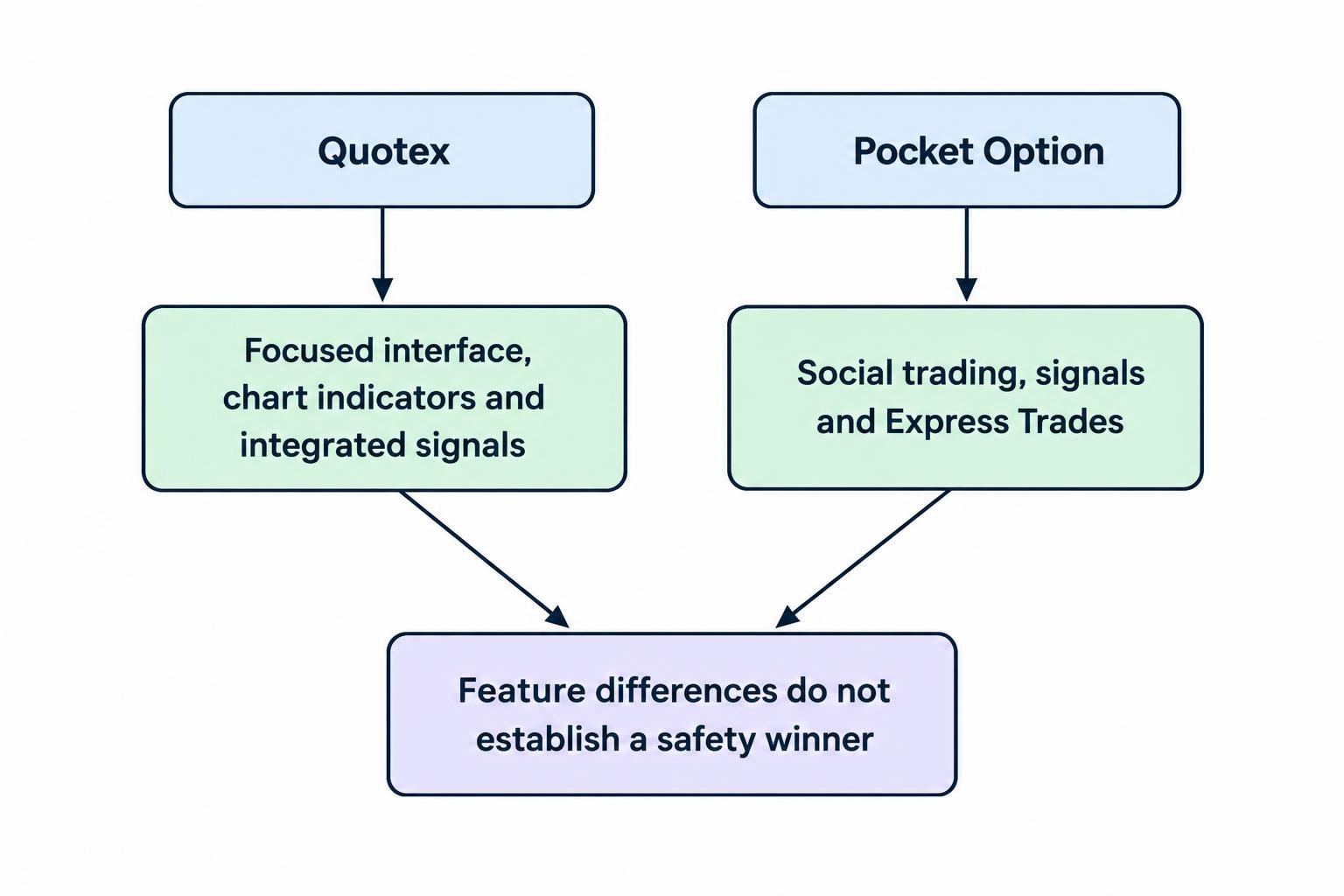
Quotex centres on a proprietary trading interface with chart indicators and trading signals. Pocket Option offers a broader collection of features, including social trading and Express Trades. The distinction is a more focused trading interface versus more account and trading functions, rather than a clear difference in safety.
| Comparison point | Quotex platform and account specifications | Pocket Option platform and account specifications |
|---|---|---|
| Published entry deposit | US$10 | US$5 |
| Demo account | Free, with US$10,000 in virtual funds | Free, with US$10,000 in virtual funds |
| Published maximum standard binary payout | Up to 98% profit on a winning contract | Up to 92% profit on a winning contract |
| Main trading interface | Proprietary web platform | Proprietary web platform, with other account products available |
| Mobile access | Android and mobile browser access | Android and mobile browser access |
| Features to assess | Chart indicators and integrated signals | Social trading, signals and Express Trades |
These figures are comparison points, not guaranteed account conditions. In particular, an advertised maximum payout should not be treated as the return available on every asset or expiry. Pocket Option’s Express Trades should also be assessed separately from standard binary contracts rather than placed in the same payout ranking.
Regulation Matters More Than the Feature List
For an Australian reader, the first question is not which platform offers more indicators. It is whether the proposed product can lawfully be issued or distributed to a retail client. Keep that question separate from whether a business has incorporated overseas, obtained a certificate or maintained an operating trading interface.
A useful review should identify the contracting company, the relevant jurisdiction and the permission covering the actual service. Do not substitute a trading brand for a legal entity. Our guide to binary options regulation in Australia covers the local framework without treating overseas registration as Australian approval.
Quotex: A Named Overseas Warning
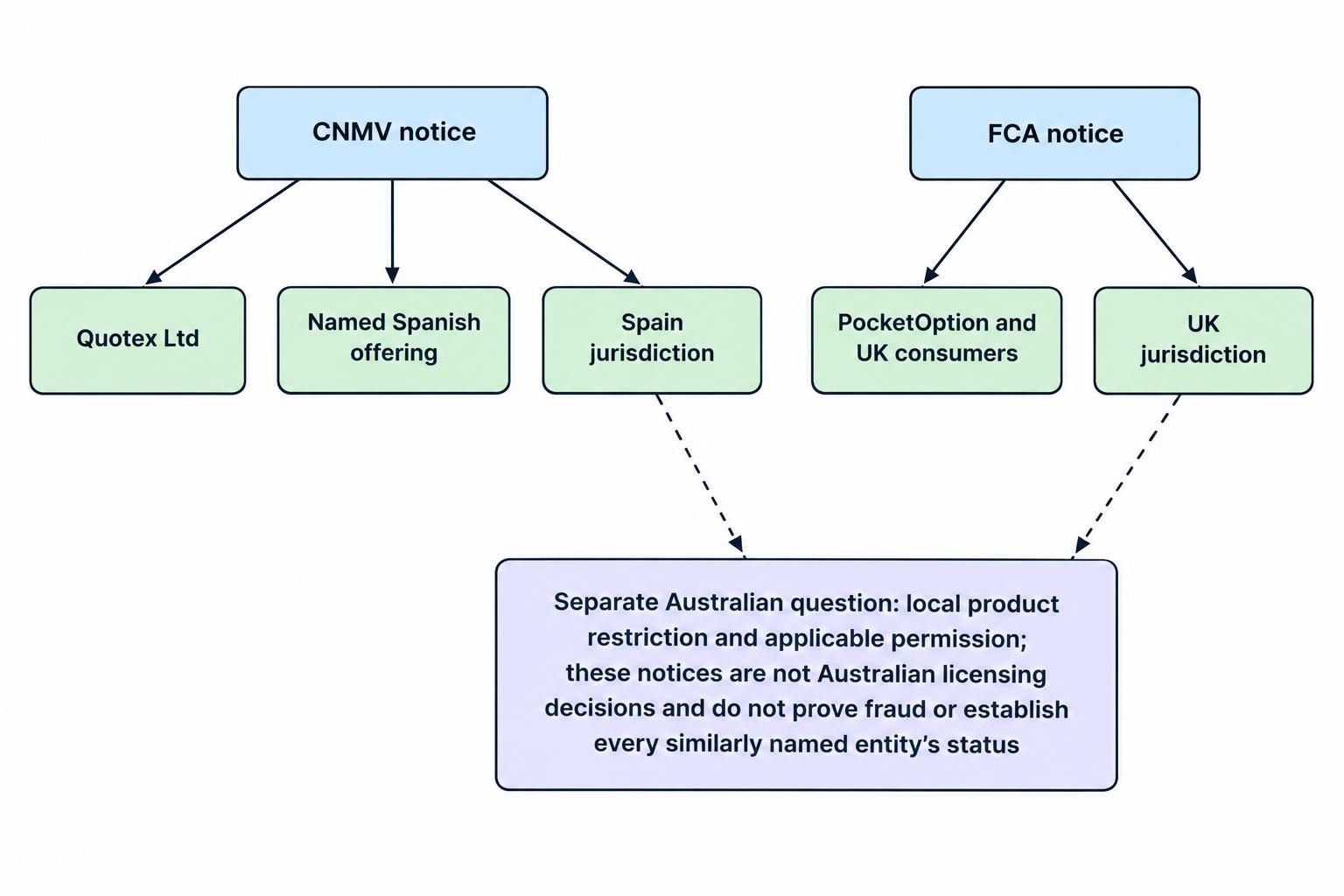
Spain’s CNMV warning dated 28 June 2021 names Quotex Ltd and its Spanish-language domain. The entry appears in the regulator’s records of unauthorised entities. The CNMV warning record for Quotex Ltd is relevant evidence about the named offering in Spain, not proof of Australian authorisation.
The date and entity name matter. Do not automatically assume an older warning identifies every later company using a similar brand. Equally, a change of company name should not be accepted as evidence that an earlier regulatory concern has been resolved. That requires a fresh check of the applicable permission.
Pocket Option: FCA Warning and UK Protection Limits
The UK Financial Conduct Authority states that PocketOption is not authorised by it and may be targeting UK consumers. Its notice also states that customers dealing with the firm will not have access to the Financial Ombudsman Service or Financial Services Compensation Scheme protection for that relationship. These are the consequences described in the FCA warning about PocketOption.
This is a UK notice, not an Australian licensing decision. It is nevertheless a reason not to treat brand recognition or a polished app as a substitute for regulatory checks. Neither warning should be stretched into a claim that every customer transaction is fraudulent. They do establish that a simple “regulated broker” label would be inadequate.
Platform Design and Demo Accounts
The useful interface comparison is about control: can you see exactly what you are selecting, recognise mistakes before submitting an order, and retrieve the resulting trade record? Counting indicators tells you much less.
For Quotex, assess whether the chart, stake field, expiry selector and payout display make the proposed contract clear. For Pocket Option, assess the same functions before considering the extra trading features. More buttons are not automatically an improvement. They can also make it easier to move between products without noticing that the settlement conditions have changed.
Where demo access is permitted, use the same exercise on each platform. Select a hypothetical stake, record the displayed expiry and payout, then compare those details with the completed trade history. Check whether the record preserves the accepted opening price, settlement time and outcome rather than only showing a green or red result.
A US$10,000 virtual balance is useful for learning the controls, but it is a poor substitute for a realistic account plan. Someone practising with US$200 virtual stakes has learned little about managing a hypothetical US$100 balance. The numbers on the screen may be pretend, the habits are not.
Demo results also cannot establish how a provider will handle identity checks, withdrawals or a dispute involving real funds. Those are different tests. The distinction is covered in our comparison of demo and live binary options trading.
Payouts: Compare the Accepted Contract, Not the Headline
The published standard payout ceiling gives Quotex an apparent advantage over Pocket Option. That is a narrow advantage: it compares maximum advertised profit percentages, not the contracts available at a matching moment.
A fair assessment needs the same underlying asset, comparable expiry, contract type and observation time. Comparing one platform’s best advertised percentage with the other’s ordinary quote is not a meaningful test. It is a comparison of two different offers.
A Hypothetical Payout Example
Suppose one contract offers an 80% net profit on a win. A US$10 winning stake produces US$8 profit, with the original US$10 returned. A loss costs the US$10 stake. Under those assumptions, the break-even win rate is:
Break-even win rate = 1 ÷ (1 + net payout rate)
At an 80% payout, that is approximately 55.56%. At 90%, it falls to approximately 52.63%. These calculations assume identical stakes, complete losses on losing contracts, and no fees or ties.
Now suppose there are 100 trades of US$10 each, with 60 wins and 40 losses. At an 80% payout, the result is US$480 in winning profits minus US$400 in losses: an US$80 net profit. At 90%, the same outcomes produce US$540 minus US$400: US$140.
That US$60 difference shows why payout matters. It does not show that either platform can deliver a 60% win rate. Nor does it account for rejected orders, different entry prices or changes in the displayed return.
Our guide to probability and expected value in binary options develops this arithmetic. For this comparison, the practical rule is straightforward: record the payout accepted for each contract. Do not apply the platform’s advertised maximum to every trade in a performance spreadsheet.
Keep Express Trades Separate
Do not compare an accumulator-style return with the payout on one ordinary high-low contract. If a product requires several conditions to succeed, its advertised return needs to be assessed against the probability of satisfying all of them.
A larger potential payment is not automatically a better-priced contract. Before comparing returns, establish what must happen to receive the payment and what happens if only part of the prediction is correct.
Markets, Expiries and Settlement Rules
An asset catalogue should be assessed by usefulness, not length. For someone studying AUD/USD, a long list of unrelated share and cryptocurrency contracts adds little. The more useful questions concern the contract actually being observed: its quote source, trading hours, available expiry and settlement calculation.
Do not assume identical asset labels mean identical contracts. Compare the full name, including any OTC designation, and check whether both offers refer to the same kind of underlying price. A familiar currency-pair label alone does not answer that question.
Our guide to price feeds and settlement benchmarks explains what to examine. For a platform comparison, retain the opening quote, accepted expiry and settlement value. A screenshot taken several seconds later may not establish what the contract recorded.
Short expiries deserve particular care. Ask whether the selector represents a countdown from acceptance or a fixed clock time. Check whether the platform confirms an order before the countdown begins, and whether the accepted terms remain visible afterward.
A shorter expiry gives you less time to respond, it does not make the prediction easier. Avoid awarding either platform extra points simply because it offers faster contracts. Speed is a product setting, not evidence of better execution or better odds.
Deposits, Withdrawals and Verification
Pocket Option’s published US$5 entry deposit is lower than Quotex’s US$10. For an Australian retail comparison, neither amount changes the product restriction. Elsewhere, where a service is permitted, the deposit threshold still says little about the cost or practicality of retrieving money.
A funding comparison should establish the payment method, account currency, conversion arrangement and withdrawal route. Keep the provider’s processing stage separate from the time a bank, wallet or payment network might take afterward. “Processed” and “received” are different milestones.
Before relying on a payment claim, obtain written answers to four questions:
- Which identity and payment-ownership documents are required?
- What minimum withdrawal applies to the chosen method?
- Are there conversion charges, network charges or intermediary deductions?
- What conditions allow a withdrawal request to be delayed, rejected or returned?
This is a document-checking exercise, not a reason to send money to test the service. A small successful withdrawal would show that one payment completed; it would not prove that every later withdrawal will complete or that the provider has adequate financial resources.
If funds are already deposited, preserve the account statements, payment confirmations, correspondence and terms that applied at the time. Do not send another payment simply because someone says it will release an existing balance. The guide to binary options withdrawal problems covers how to organise evidence and assess the next steps.
Support should be judged on the substance of its answers. A quick greeting is less useful than a clear explanation of an outstanding verification request or the contractual basis for a payment decision. Keep those exchanges in writing where possible.
Signals, Copy Trading and Bonuses
Pocket Option’s social trading features are a distinction for readers comparing functions. Quotex’s integrated signals serve a different purpose: a suggestion about a trade is not the same as automatically copying another account.
Neither function should receive a favourable score without evidence about results and execution. For signals, ask whether a complete history includes losing suggestions, timestamps, entry assumptions and the payout available when the signal appeared. A screenshot of selected winners does not answer those questions.
For copy trading, examine whether the record shows closed trades, changes in stake size and the worst decline in account value. A high win rate can conceal poor risk control if occasional losses are much larger than ordinary wins.
Execution also belongs in the comparison. A copied trade entered later may have a different opening price, remaining duration or payout. Do not assume a follower receives the same contract economics as the account being followed.
Apply the same scepticism to bonuses. Before assigning any value to a promotion, establish whether it is withdrawable cash, trading credit or a conditional adjustment. Check the turnover calculation, treatment of losses and effect of cancelling the promotion.
A hypothetical US$50 credit requiring US$5,000 of qualifying turnover should not be valued like an unconditional US$50 payment. Its value depends on the obligations attached to it. A comparison that adds a bonus to the deposit balance but leaves out those obligations gives a distorted picture.
How to Read Quotex and Pocket Option Reviews
Look for evidence that answers the comparison rather than a numerical score on its own. A useful review distinguishes advertised conditions from observed behaviour, identifies the account and jurisdiction being discussed, and dates claims that may change.
Do not turn another writer’s platform experience into a universal promise. An interface assessment may be useful, but it does not establish how every account will be handled. The same applies to customer complaints: a documented case deserves attention, while an anonymous accusation without supporting records cannot establish what happened.
Pay particular attention to mismatched categories. A review may discuss binary contracts, forex accounts and other products under one brand. That does not mean every feature, permission or account condition applies to all of them.
For this comparison, the strongest evidence would connect each claim to the relevant product: the accepted payout for a contract, the terms governing a withdrawal, or the regulator’s record for a named entity. General popularity is a much weaker basis for deciding where money belongs.
Which Platform Comes Out Ahead?
On the published specifications, Quotex has the higher standard binary payout ceiling. Pocket Option has the lower entry deposit and a broader set of trading functions. Neither point establishes a safety winner, and neither outweighs the Australian retail restriction.
For interface study where access is permitted, compare contract clarity, order records and the ability to practise a repeatable process. For any assessment involving real funds, permission, custody arrangements and enforceable complaint routes belong ahead of convenience.
Do not accept wholesale classification simply to gain access to binary options. ASIC’s Moneysmart warning on binary options explicitly cautions against this and notes that wholesale clients do not have the same consumer protections as retail clients.
The practical verdict for Australian retail readers is neither for live binary options trading. The feature comparison explains how the products differ; it should not be mistaken for a recommendation to fund either account.
This article was last updated on: October 22, 2026