A binary options practice plan should answer three questions: can you apply a rule consistently, can you record the outcome accurately, and does the payout arithmetic support your interpretation of the results? A rising virtual balance answers none of these on its own.
For Australian readers, this is an educational exercise, not a route into live trading. ASIC’s binary options product intervention order bans the issue and distribution of binary options to retail clients until 1 October 2031. Completing a practice programme does not change that restriction.
The four-week plan below uses simulated stakes, written rules and separate review periods. Its purpose is to produce an honest record, including evidence that a trading idea does not work. That is a useful result, even if it makes a rather dull screenshot.
Set Up the Exercise Before Recording Trades
Use a spreadsheet, a notebook or a chart replay tool that lets you hide future prices. You do not need to deposit money or open a brokerage account. The method in our guide to paper trading binary options can provide the basic recording framework.
Keep the first exercise narrow: one underlying market, one contract type, one expiry rule and one observation window. Changing all four after a losing session makes it impossible to tell what you have tested.
Write a short practice specification before starting:
- Price data: name the data provider and price field used for entry and settlement.
- Decision rule: describe exactly what must happen before a simulated entry qualifies.
- Timing: state when you observe prices, when entry occurs and how expiry is calculated.
- Payoff: define the hypothetical winning profit, losing amount and treatment of equality.
- Stake: use the same virtual amount throughout the test.
- Exclusions: list conditions that prevent an entry, such as missing data or an unfinished signal.
For a bookkeeping exercise, you might use a hypothetical A$1,000 balance and A$10 stakes. These figures make calculations easy; they are not a recommendation about real account size or acceptable financial risk.
Ordinary market data can support a price-direction exercise. It cannot establish how a particular provider would quote, accept or settle a real contract. Label the exercise accordingly rather than presenting a homemade simulation as verified platform performance.
A Four-Week Binary Options Practice Schedule
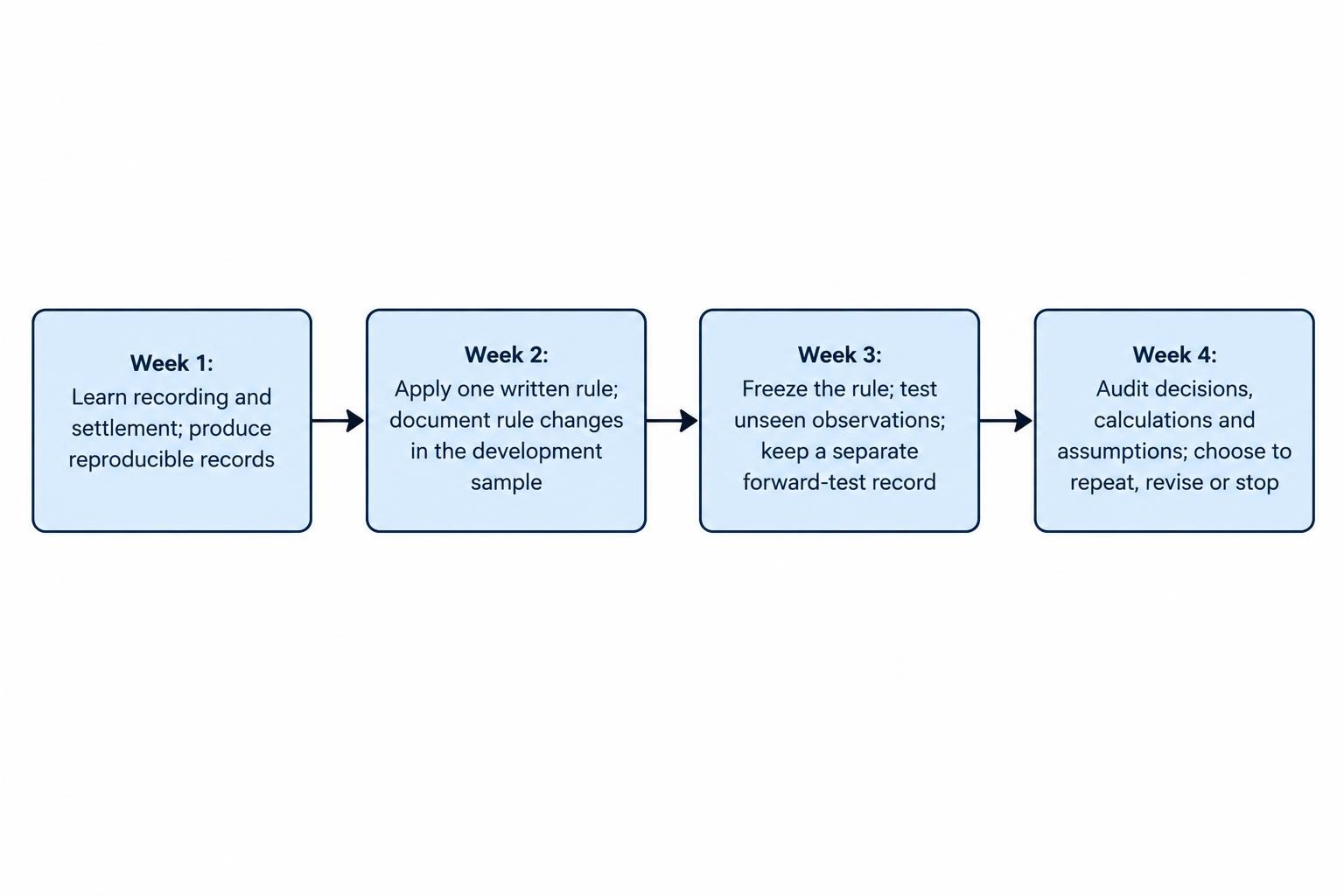
Treat this schedule as a structure for learning, not a countdown to profitability. Three to five sessions of around 30 minutes each week provide a workable starting routine. Extend a stage whenever the records reveal an unresolved problem.
| Stage | Main task | Required output |
|---|---|---|
| Week 1 | Learn the recording and settlement process | Complete, reproducible practice records |
| Week 2 | Apply one written decision rule | A development sample with every change documented |
| Week 3 | Test the frozen rule on unseen observations | A separate forward practice record |
| Week 4 | Audit decisions, calculations and assumptions | A written decision to repeat, revise or stop |
Do not set a minimum number of entries per session. A session with no qualifying conditions should produce no entries. Creating trades to fill a spreadsheet is still overtrading, even when the money is imaginary.
Week 1: Make the Mechanics Reproducible
Spend the first week checking whether another person could reconstruct each simulated outcome from your notes. Profit is not the assessment criterion yet.
Record the market, direction, entry timestamp, entry price, expiry timestamp, settlement price and hypothetical payoff. Use one stated time zone throughout. Keep screenshots where useful, but retain the actual numbers too; an image with an unreadable price label is decoration, not evidence.
Separate the chart from the settlement rule
A candle can show price movement without providing the exact observation required at expiry. If your exercise settles at 10:15:30, a five-minute candle closing at 10:20 does not establish the settlement price.
Define whether you use an observation at the exact timestamp or the first available observation after it. If the required data is missing, mark the result as unresolved. Do not choose whichever nearby price produces the preferred outcome.
Practise equality cases deliberately. A higher contract ending exactly at its strike might receive different treatment under different contract terms. For a homemade exercise, choose and disclose a hypothetical rule; for contract analysis, use the actual settlement and tie conditions. Never silently count every tie as a refund.
Check profit against total return
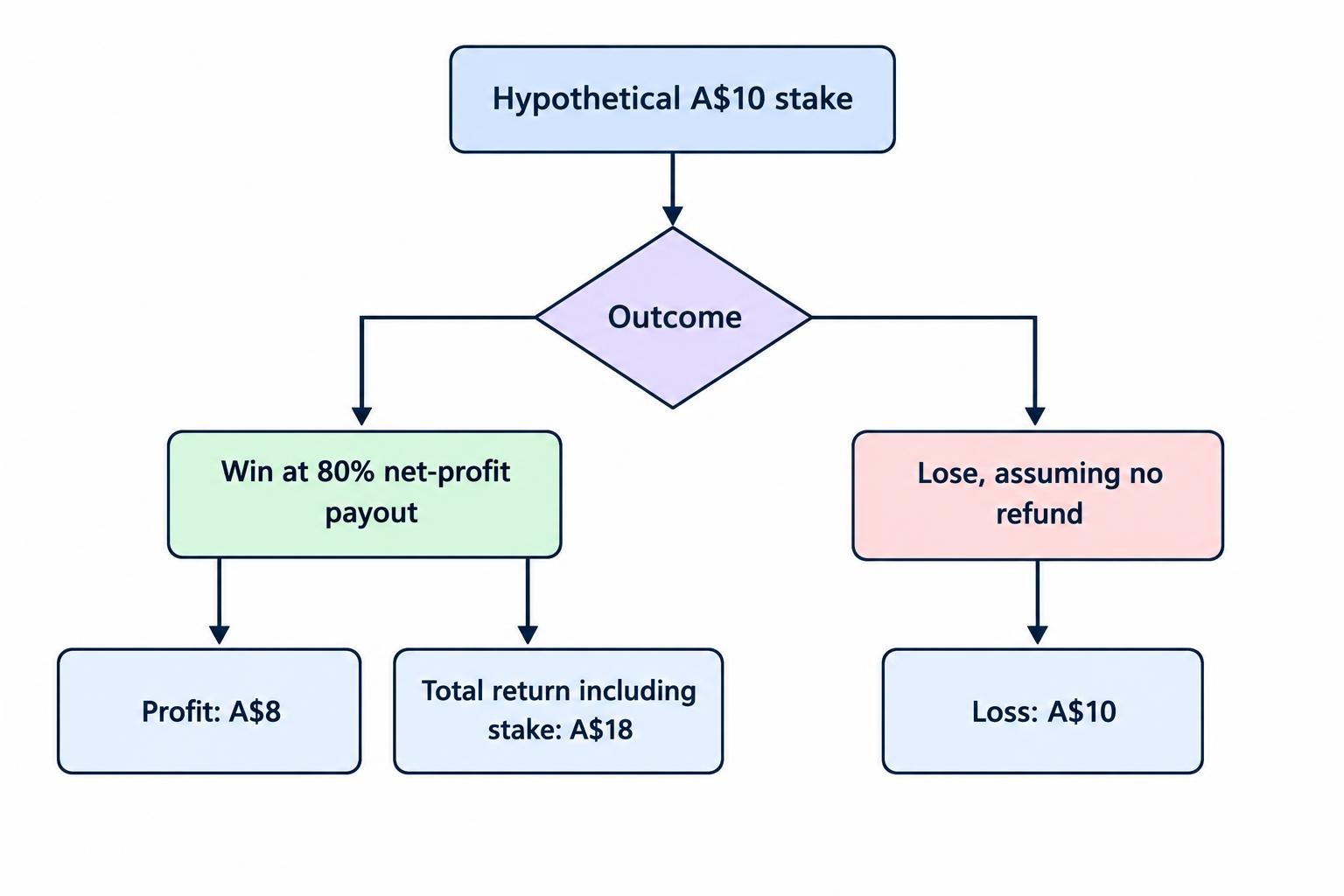
Under a hypothetical 80% net profit payout, a winning A$10 stake generates A$8 profit and returns A$18 including the stake. A losing contract loses A$10, assuming no refund. Recording A$18 as profit exaggerates the result by A$10.
Finish the week by recalculating several entries manually. If your records contain unexplained prices, missing timestamps or inconsistent payouts, repeat this stage before testing a trading idea.
Week 2: Practise One Written Rule
Choose a rule that can be checked without hindsight. “Enter when momentum looks strong” leaves too much room for interpretation. State the observable condition, the decision time and the entry convention.
For a purely educational example, you could record a hypothetical higher position at the first available quote after a completed five-minute candle closes above the previous candle’s high. Set expiry exactly 15 minutes after the recorded entry timestamp, and allow only one simulated position at a time. This is an exercise in consistent measurement, not a claim that the rule has an advantage.
Use the same price field throughout. Do not identify a signal using one feed, select a favourable entry from another and settle against a third. If you cannot obtain the required observations, choose a simpler recording exercise.
Keep development separate from evaluation
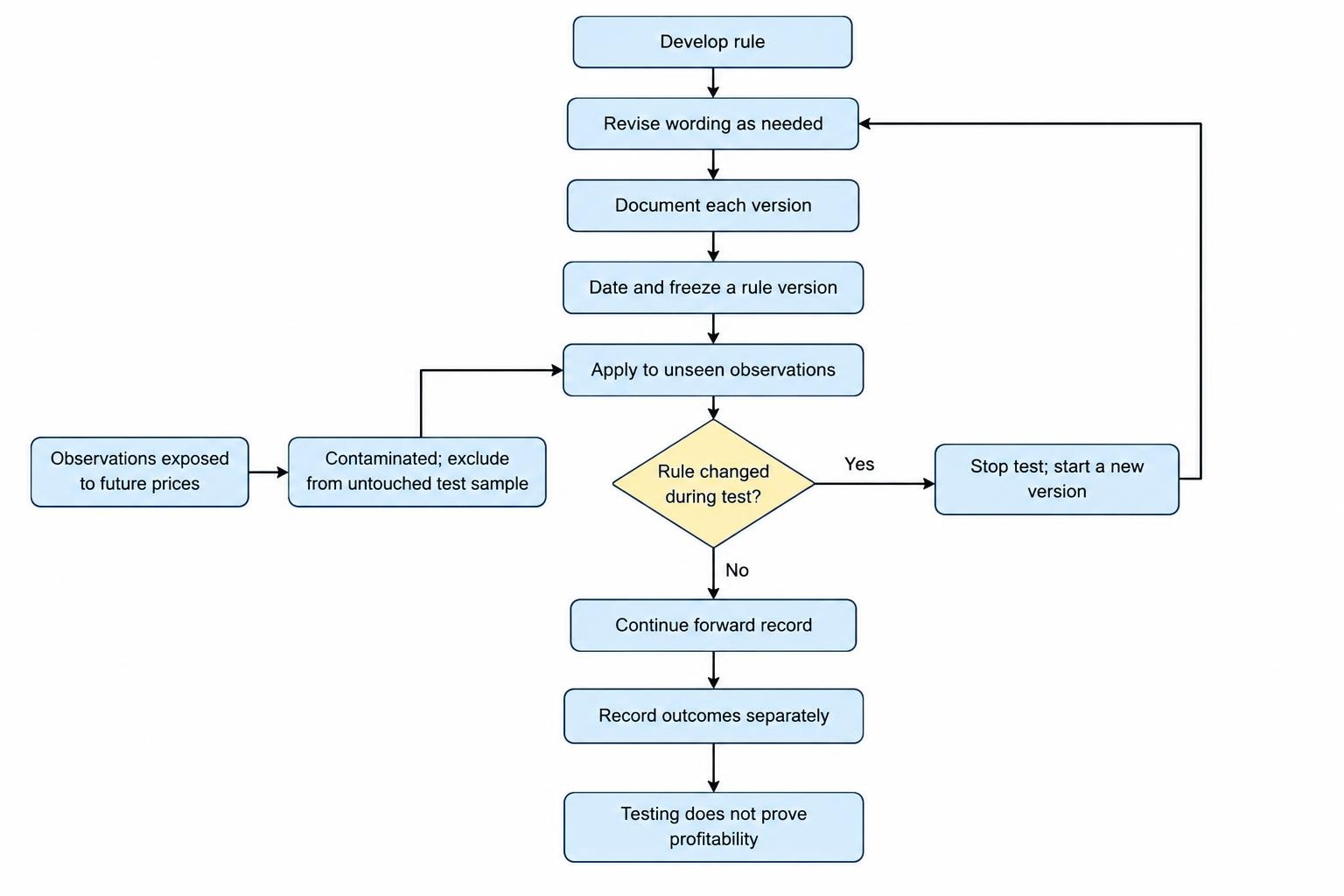
You may find that the wording needs revision. Perhaps “first available quote” needs a clearer timestamp convention, or your software cannot reproduce the chosen expiry. Make the revision, assign a new version number and record when it took effect.
Do not combine results from several versions and call them one strategy. Each revision changes what you are evaluating. A good result from an abandoned rule does not belong in the performance record of its replacement.
Use a trading journal to keep the rule version, decision evidence and outcome together. Record errors as errors, including accidental entries that happen to win. A profitable mistake is still a mistake.
Week 3: Freeze the Rules and Observe New Data
Before week three begins, save a dated copy of the final rule. Then apply it to observations you have not already inspected. Keep these results separate from the development records.
This separation is the purpose of forward testing a binary options rule: the decisions must exist before their outcomes are known. You can practise with prices arriving in real time or with a replay that genuinely hides what happens next.
Do not rewind a losing decision and replace it with a better one. If you accidentally reveal future prices, label that observation as contaminated and keep it outside the untouched test sample.
Use a repeatable session routine
Before the session: check the rule version, data availability and observation window. Write down the session’s start and finish times. A hypothetical stopping condition, such as ending after a recording error, should be decided now rather than after a disappointing result.
During the session: record qualifying decisions before expiry. Note why an apparent opportunity was rejected when that helps explain the rule. Keep the virtual stake unchanged after wins and losses.
After the session: reconcile the balance, check missing fields and classify errors. Do not rewrite the entry rationale to match the outcome. Leave proposed improvements in a separate review note.
If a rule needs changing during this stage, stop the test and begin a new version. The calendar does not outrank the evidence. Finishing four weeks with fewer usable observations is better than finishing with a polished but unreliable record.
Week 4: Audit the Process and the Arithmetic
Review process quality before looking at returns. Otherwise, a lucky result can excuse poor decisions and a losing result can make a correctly followed rule look like an execution failure.
Measure rule compliance
Calculate the proportion of recorded entries that followed the written rule. Include accidental and impulsive entries in the denominator. Keep a separate count of missed qualifying opportunities, incomplete records and unresolved settlements.
For this exercise, require complete contract fields and a clearly reproducible outcome for every entry included in the main results. Keep excluded observations visible, with reasons. An exclusion log prevents missing data from becoming a convenient hiding place for losses.
Compare compliant and non-compliant entries separately, but retain the combined account record. The first comparison evaluates the rule; the combined record shows what you actually did.
Calculate the payout-adjusted result
Win rate is not enough. With an 80% net profit payout and a full stake lost on unsuccessful entries, the break-even win rate is 1 divided by 1.8, or approximately 55.56%, before fees. The calculation follows the relationship between binary options probability and expected value.
Consider 100 hypothetical entries with A$10 stakes, identical 80% winning payouts, no ties and no other costs. If 56 win and 44 lose, winning profits total A$448 and losses total A$440. Net profit is just A$8.
That positive result is not proof of a repeatable advantage. It describes one sample under stated assumptions. One entry incorrectly recorded as a win rather than a loss would change the total by A$18, turning the A$8 profit into a A$10 loss.
Recalculate using a lower hypothetical payout too. At 70%, break-even rises to approximately 58.82%. This sensitivity check shows whether the apparent result depends on a favourable payout assumption rather than the quality of the decisions.
Keep uncertainty visible
Four weeks is a scheduling choice, not a statistical validation standard. A small sample can produce an attractive win rate through chance. Repeated observations from the same session may also reflect the same conditions rather than independent evidence.
Record the sample size, dates, payout assumptions and rule changes beside the result. Avoid turning a short run into a monthly income projection. There is no honest conversion from “this exercise made A$8” to “this will pay the rent”.
Decide What the Practice Record Supports
At the end of the programme, choose between repeating the unchanged exercise, revising one clearly identified weakness, or stopping. There is no obligation to rescue an idea because you spent time testing it.
Repeat the mechanics stage if settlement remains unclear. Return to development if the rule needs rewriting. Continue collecting untouched observations only when the process is reproducible and the existing records remain intact.
Do not treat a simulation as a broker safety check. It cannot establish solvency, withdrawal reliability or the integrity of a real trading platform. The SEC and CFTC investor alert on binary options fraud documents complaints involving withheld funds, identity theft and alleged software manipulation. A virtual winning streak does not test those risks.
The useful output is a dated rule, an auditable record and a restrained interpretation. If the exercise teaches you to reject unclear contracts, question flattering results and stop when the evidence is weak, it has served its purpose. No deposit required.
This article was last updated on: October 22, 2026